
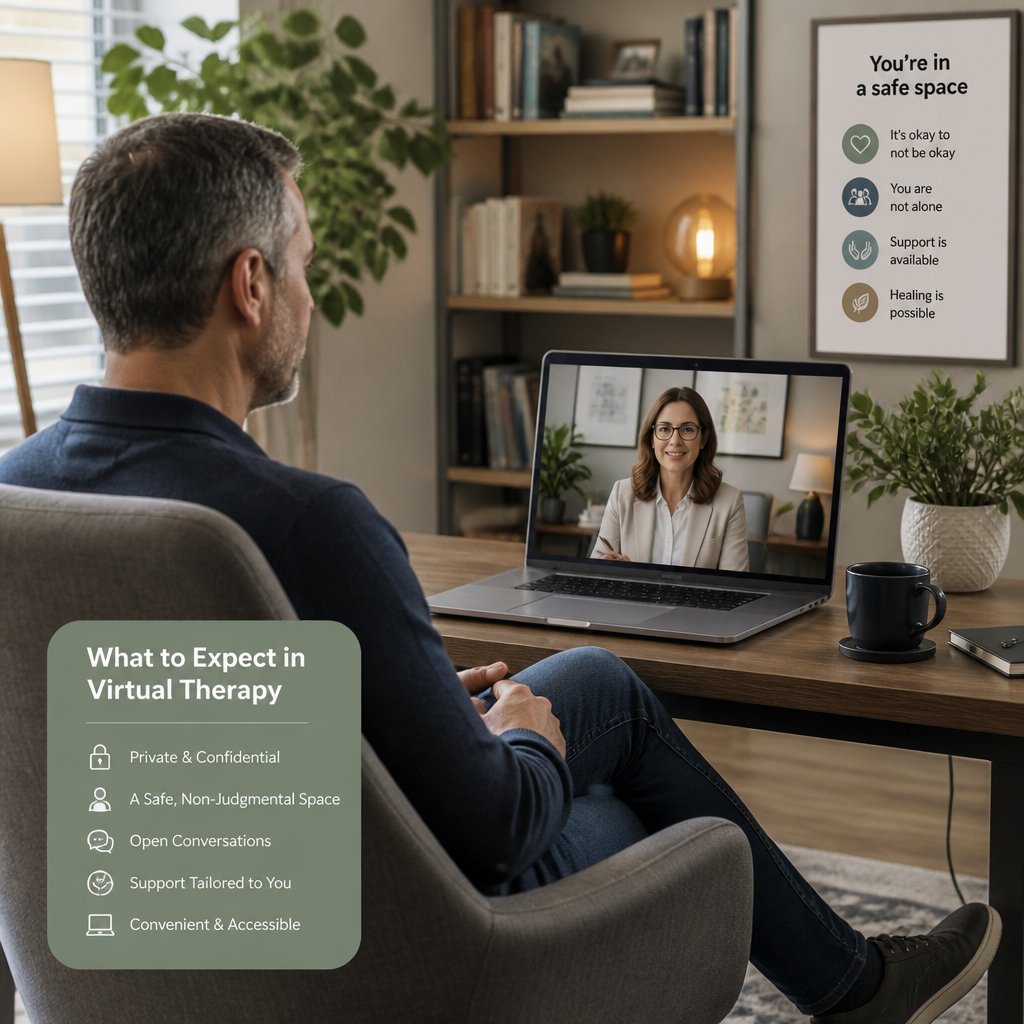
Seeking mental health support looks pretty different these days. Now, you can sit in your living room, your car, or even a tucked-away spot at work and talk to a licensed therapist—no waiting room required. Virtual therapy for adults has made it so much easier to get help that actually fits into your life. Whether you’re wrestling with anxiety, processing a tough transition, or just feeling off, teletherapy meets you where you are.
Online counseling carries the same clinical weight as in-person sessions. Research keeps showing that virtual mental health care works for all sorts of concerns, from depression and stress to trauma and relationship issues. The setting changes, but the work is just as real.
If you’re wondering what therapy actually looks like when it’s online, you’re not alone. Here’s a look at what to expect, how sessions usually go, what kinds of approaches therapists use, and how to find the right fit for you.
Key Takeaways
- Virtual therapy is effective for anxiety, depression, stress, trauma, and plenty of other things adults deal with.
- Sessions are flexible, private, and more accessible, so it’s easier to keep up with support.
- Finding a therapist and approach that fit you really matters—it’s okay if it takes a little time.
How Virtual Care Supports Adults Day To Day
Online therapy breaks down a lot of the old barriers that kept people from getting help. Packed schedules, no easy transportation, or just not wanting to run into someone you know at a local office—virtual therapy solves problems that can otherwise keep folks waiting. More affordable online options have opened the door for people who thought counseling was out of reach.
Common Reasons Adults Reach Out
Adults turn to therapy for all sorts of reasons—there’s really no issue too small or too big to bring up. Some of the most common reasons include:
- Anxiety, worry, or racing thoughts
- Depression or just feeling low
- Stress, burnout, or exhaustion from work or caregiving
- Big life changes (divorce, job loss, moving)
- Relationship or communication struggles
- Grief and loss
- Low self-esteem or self-doubt
- Trauma and its ripple effects
- Feeling overwhelmed or struggling to manage emotions
Therapy isn’t just for crisis moments. Sometimes, people start because they just want to feel better and show up more fully in their lives.
When Online Sessions Can Make Life Easier
Virtual therapy fits into your life in ways that in-person appointments sometimes just can’t. If you work long hours, have kids at home, live far from providers, or have health issues that make getting out tough, online sessions take away those barriers.
Most sessions happen over secure video, though you can use the phone with many therapists. You pick a private, comfortable spot, log in at your scheduled time, and talk with your therapist just like you would in person. For adults juggling a lot, that flexibility can mean finally getting help instead of putting it off again.
Virtual Care Vs. In-Person Support In Chicago
In Chicago, choosing between virtual and in-person therapy is really about what works for you. Both are effective, and plenty of people switch back and forth depending on the week. In-person sessions can offer a sense of dedicated space and physical presence—sometimes that feels grounding, especially when tackling heavy stuff. Virtual sessions are great for maintenance, busy weeks, or when you just want to stay in your own space. Tides Mental Health offers both, so you don’t have to compromise.
What A Session Usually Looks Like
Online therapists know how to create a safe, supportive space—even through a screen. Whether it’s your first session or you’ve been meeting for months, the structure stays pretty consistent, which can be reassuring.
Intake, Goals, And Early Conversations
Your first few sessions are about getting to know each other. Your therapist will ask about your background, what brought you to therapy, and what you want to get out of it. Sessions usually run 45 to 60 minutes, often at the same time each week.
Early conversations often cover:
- What’s been weighing on you lately
- Your history with mental health support (if any)
- Relationships, work, and daily routines
- What you’re hoping will change
This helps your therapist get a full picture and tailor the work to you, not just use a generic approach.
How Comfort And Privacy Shape The Experience
One thing people notice quickly: being in your own space can make it easier to open up. You control your environment. Pick a room where you feel safe, pop on headphones for privacy, or just settle in wherever you’re comfortable.
If privacy at home is tricky, lots of people take sessions from their car, a quiet library room, or even a private office. Therapists get that virtual sessions come with real-life logistics, and it’s normal to check in about your comfort at the start.
Building A Strong Therapeutic Relationship Online
The bond you build with your therapist is key—it really does develop through a screen. Virtual therapists know how to create connection, pick up on emotional cues, and build trust, even if you’re not sitting in the same room.
With time, sessions start to feel natural, and your therapist gets to know you. Trust grows from being heard and not judged. Turns out, you don’t have to share physical space for that to happen.
Approaches That Work Well In A Virtual Setting
Most evidence-based therapies work just as well online. CBT, DBT, trauma-focused therapies, and relational approaches all translate to video sessions. Your therapist will pull from the methods that fit your goals and history. The virtual format doesn’t limit the depth or quality of the work.
CBT For Anxiety, Stress, And Negative Thought Patterns
Cognitive behavioral therapy, or CBT, is one of the most widely used approaches in online therapy. It focuses on the connection between your thoughts, feelings, and behaviors. If you’re stuck in anxious thinking, self-criticism, or avoidance, CBT gives you tools to break those cycles.
In virtual sessions, CBT works well because it’s mostly conversation, reflection, and skill-building you can practice at home. Your therapist might:
- Help you spot thought patterns that make anxiety worse
- Guide you through exercises to challenge unhelpful beliefs
- Support you in building coping strategies for stress
- Suggest things to try between sessions
CBT isn’t about forced optimism. It’s about helping you see your thoughts more clearly so they don’t run the show.
DBT Skills For Emotional Overwhelm And Communication
Dialectical behavior therapy, or DBT, helps people who have intense emotional reactions. It blends acceptance with practical change and teaches skills in four areas: mindfulness, distress tolerance, emotion regulation, and interpersonal effectiveness.
DBT skills groups can be offered virtually, which makes them more accessible if you struggle with emotional overwhelm, relationship conflict, or impulsive reactions. Even in one-on-one sessions, DBT skills can be powerful for adults dealing with anger, rocky relationships, or emotional ups and downs.
The skills you learn in DBT are practical—you try them out in real life and talk about what comes up with your therapist.
Support For Trauma, Self-Esteem, And Relationship Challenges
Not all therapy fits into a neat box. For trauma recovery, therapists might use trauma-focused CBT, EMDR, or somatic techniques, depending on your needs. When it comes to self-esteem or relationship challenges, therapy often focuses on understanding old patterns and learning new ways to respond now.
Virtual sessions work well for this kind of deep, relational work. You might explore how past experiences shaped your self-image, how anxiety plays out in your relationships, or how old wounds affect the way you connect with others. The relationship with your therapist often becomes part of the healing process.
Choosing The Right Type Of Mental Health Support
Mental health care isn’t one-size-fits-all. The kind of provider you work with depends on what you’re facing and what kind of support makes sense. Different providers bring different training and areas of expertise, so knowing the basics helps you choose.
Therapy, Couples Counseling, And Family Counseling
Individual therapy is for working through personal challenges, building coping skills, or processing something that’s weighing on you. Couples counseling brings both partners together to work on communication, conflict, or transitions. Family counseling includes several family members and focuses on dynamics, boundaries, and how everyone’s patterns affect the group.
All these can be done virtually. Licensed marriage and family therapists (LMFTs) have special training in relational work and are often great for couples and families. Licensed clinical social workers (LCSWs) often take a holistic approach and can work with individuals, groups, and families.
When Psychiatry Or Medication May Be Part Of Care
Some people benefit from both therapy and medication. Online psychiatry lets you meet with a psychiatrist or psychiatric nurse practitioner virtually for evaluation and medication management. Psychiatrists are medical doctors focused on mental health and can prescribe medication if needed.
You don’t have to take medication for therapy to work, and lots of people make progress through talk therapy alone. If medication is part of your care, it usually works best alongside regular therapy—not as a replacement.
Provider Types And Therapist Qualifications
Therapist qualifications can be confusing. Here’s a quick cheat sheet:
| Credential | What It Means |
|---|---|
| LCSW | Licensed Clinical Social Worker, trained in therapy and social support |
| LMFT | Licensed Marriage and Family Therapist, specializes in relational work |
| Psychologist | Doctoral-level clinician trained in assessment and therapy |
| Psychiatrist | Medical doctor specializing in mental health, can prescribe medication |
| Psychiatric Nurse Practitioner | Advanced practice nurse who can prescribe and manage medication |
All licensed therapists and prescribers have to meet state requirements for education, supervised hours, and exams. When you’re looking at providers, it’s always fair to ask about their licensure and specialties.
How To Know If A Therapist Is A Good Fit
Finding the right therapist can take some effort, and it’s normal if the first one you try isn’t the perfect match. The connection you feel with your therapist is one of the biggest factors in whether therapy helps, and sometimes it takes a bit to find.
Questions To Ask Before You Begin
Before you commit, don’t be shy about asking a few direct questions. Most therapists offer a brief consultation and welcome these conversations. You might ask:
- What’s your experience with [anxiety, depression, trauma, etc.]?
- What approach do you usually use?
- How do you structure sessions and set goals?
- What’s your availability and how do you handle scheduling?
These questions help you get a sense of their style and whether it clicks for you. A good therapist won’t mind—they’ll appreciate your thoughtfulness.
Signs It May Help To Switch Therapists
It’s normal to feel a bit awkward in the first few sessions. But if you still feel disconnected after a while, it might be time to try someone else. Consider switching if:
- You keep feeling unheard or misunderstood
- Sessions feel stuck and nothing’s changing
- You feel judged or dismissed
- You’re not sure your therapist understands your goals
Switching therapists is totally okay if things aren’t working. Some platforms make it easy, and finding the right fit can make all the difference. If video sessions feel too intense at first, text or chat therapy might be worth trying.
What Progress Can Realistically Feel Like
Progress in therapy almost never moves in a straight line. One week you might feel like you’re finally getting somewhere, and the next, you’re right back in the thick of it. Some sessions bring relief, while others just feel tough. At first, progress might look more like noticing your patterns than suddenly feeling better.
Over time, you might catch yourself reacting to stress in new ways, speaking up more clearly, or feeling a little less stuck in thoughts that used to take over. Real change tends to sneak up slowly, not all at once. The point isn’t to erase all struggle from your life—it’s to learn how to move through it with a bit more skill and a little more kindness toward yourself.
Cost, Access, And Practical Options
Let’s be honest: cost often stops adults from starting therapy. It’s a valid concern—one that shouldn’t be brushed aside. The upside? Virtual care has opened a lot of doors, and there are more affordable, flexible choices now than just a few years back.
Insurance, Employee Benefits, And Flexible Care
A surprising number of health insurance plans now cover virtual therapy, often just like they do for in-person visits. Before you jump in, it’s smart to call your insurance company and ask about your mental health benefits, copays, and whether your chosen provider is in-network.
Don’t forget about employee assistance programs, or EAPs. Many workplaces offer these, and they usually include a handful of free sessions with a licensed therapist. If your job has an EAP, it could be an easy way to get started without a big commitment.
Online therapy platforms have also made it simpler to use your insurance for virtual care.
When Lower-Cost Or Free Support May Help
No insurance? Or maybe your plan doesn’t cover therapy? There are still ways in. Free online resources, sliding scale fees, and group therapy online can all help lower the cost.
Platforms like Talkspace, BetterHelp, Brightside Health, MDLive, Grow Therapy, Teladoc Health, Talkiatry, and Online-Therapy.com each bring something different to the table. Brightside zeroes in on anxiety and depression. Talkiatry takes insurance and blends psychiatry with therapy. Grow Therapy connects people to in-network providers in lots of states.
What’s “best” really depends on what you need, your budget, and whether you want to use insurance, need a certain specialty, or prefer a subscription model. Taking some time to compare options can save you both money and stress down the road.
How To Start With Tides Mental Health
For those in Chicago—or anyone looking for a practice that actually feels welcoming—Tides Mental Health offers both virtual and in-person sessions for adults. Getting started isn’t complicated: you reach out, share a bit about what’s going on, and get matched with a therapist whose background fits your needs.
Whether you’re wrestling with anxiety, burnout, a big life change, or just a vague sense that something’s off, the team at Tides Mental Health gets it. You don’t have to have everything sorted out to start therapy. Honestly, you just have to show up.
Frequently Asked Questions
How much does an online therapy session typically cost?
Without insurance, online therapy sessions usually run between $70 and $200 per session, depending on the provider and platform. Many online therapy sites offer subscriptions that can lower the per-session cost. If you have insurance, your copay might be much less.
Can I use my health insurance to pay for online therapy?
Yes, a lot of insurance plans cover virtual therapy just like in-person visits. Make sure the therapist or platform you’re considering is in-network with your plan before you book. Calling your insurance provider directly is usually the best way to get clear info about costs.
Are there affordable options for online therapy if I don’t have insurance?
Definitely. Sliding scale fees, employee assistance programs, and online group therapy are all worth looking into. Some platforms adjust their rates based on your income, and community mental health centers often have sliding scales too.
Does Medicaid cover online mental health therapy services?
In many states, Medicaid does cover teletherapy, but the details can change depending on where you live and which provider you choose. It’s best to check with your state’s Medicaid office or call a provider to ask if they accept your plan. Telehealth options under Medicaid have grown a lot lately.
Can online therapy include medication management if I need it?
Yes. Online psychiatry services let you meet with a psychiatrist or psychiatric nurse practitioner virtually for assessment and medication management. Some platforms offer both therapy and psychiatric care in one place, which can make coordinating your treatment a lot easier.
Can talk therapy help with serious mental health conditions like schizophrenia?
Talk therapy can play a real role in treating serious mental health conditions, even ones as complex as schizophrenia. Usually, it works best when paired with psychiatric care and medication—these combinations tend to offer the most stability. A licensed therapist can offer support, help you find ways to cope, and be a steady presence during tough stretches. Meanwhile, a psychiatrist handles the medical side of things. Most people find that a team approach just makes sense.