
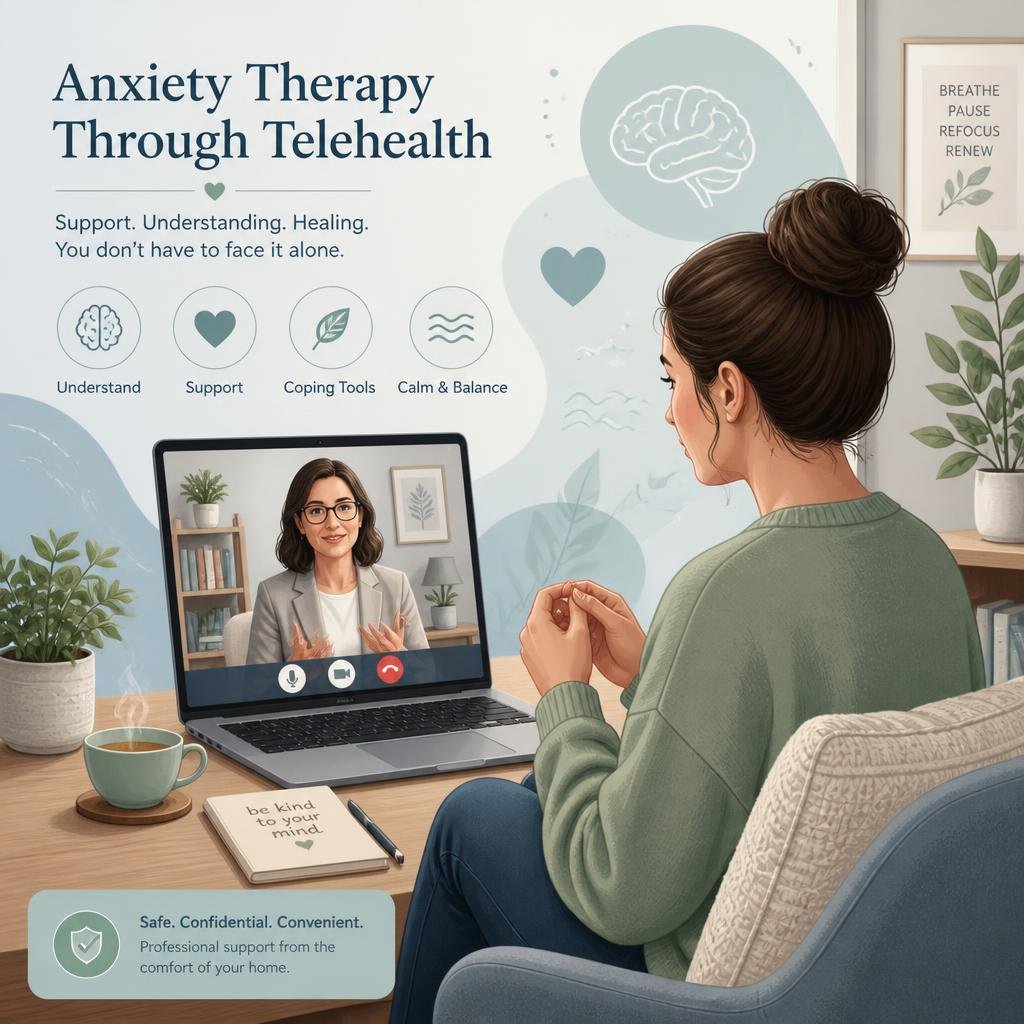
You may be considering telehealth therapy for anxiety because you want care that fits your schedule and feels easier to start than office visits. Virtual therapy can support anxiety treatment through secure video sessions, structured skills work, and ongoing contact with a licensed therapist.
For many adults, telehealth therapy for anxiety offers the same core elements you would expect in person, including assessment, diagnosis when appropriate, and evidence-based treatment. It can also reduce common barriers like commute time, missed work, and the stress of getting to an office when you already feel overwhelmed.
How Telehealth Therapy For Anxiety Works
Telehealth therapy for anxiety usually starts with an intake visit, where you talk about your symptoms, history, goals, and what makes anxiety better or worse. From there, your therapist builds a plan that may include coping skills, behavior changes, and regular check-ins through online therapy or virtual therapy.
The format is simple, but the clinical work is still serious. A strong therapeutic alliance can form through video, and many people find that virtual care feels less stressful at first because they can join from a familiar space.
What A Virtual Therapy Session Looks Like
You usually log in a few minutes early, check your camera and sound, and meet with your therapist in a private video room. The session often lasts 45 to 60 minutes, with time spent on symptom check-ins, skill practice, and planning for the week.
For anxiety, your therapist may ask you to track triggers, physical symptoms, and avoidance patterns. You may leave with a small action step, such as practicing a breathing skill, testing an anxious prediction, or completing a behavior worksheet.
Who Telehealth Is A Good Fit For
Virtual care works well if you want convenient support, live far from a clinic, have a busy schedule, or feel more comfortable talking from home. It can also help if driving, parking, or sitting in a waiting room increases your anxiety.
Many adults use telehealth for worry, panic, social anxiety, life transitions, and stress linked to work or relationships. At Tides Mental Health, this often fits adults who want therapy for anxiety, depression, or relationship strain with a mix of virtual and in-person options.
When In-Person Care May Be Better
In-person care may be a better choice if your symptoms are severe, safety is a concern, or you need a level of structure that is easier to provide face to face. Some people also prefer office visits when they want fewer home distractions.
If you are in crisis, having thoughts of self-harm, or dealing with complex medical or psychiatric needs, in-person evaluation may be more appropriate. A good clinician will help you decide the safest level of care.
The Most Effective Therapy Approaches For Anxiety Online
Online anxiety treatment works best when it uses proven methods, not just general supportive talk. For many anxiety disorders, the strongest results come from structured care that targets avoidance, unhelpful thinking, and fear-based habits.
Cognitive Behavioral Therapy And CBT Skills
Cognitive behavioral therapy is one of the most common and useful approaches for anxiety. In CBT, you learn how thoughts, feelings, and behaviors affect one another, then practice changing the patterns that keep anxiety going.
You may work on thought records, worry tracking, relaxation skills, and behavior experiments. In telehealth, these tools are easy to share on screen, and many clients like being able to practice them in real time at home.
ACT For Worry And Avoidance
ACT, or acceptance and commitment therapy, helps you respond to worry with more flexibility. Instead of fighting every anxious thought, you learn to notice it, make room for discomfort, and focus on what matters to you.
This approach can be useful when anxiety has led to avoidance, perfectionism, or overthinking. It is often helpful for people who want less symptom pressure and more follow-through in daily life.
Exposure Therapy In A Telehealth Setting
Exposure therapy can also work online when it is planned carefully. You and your therapist can build a fear ladder, then practice facing situations, sensations, or thoughts in small steps from your own environment.
For example, you might practice making a phone call, entering a social setting, or sitting with a body sensation linked to panic. In telehealth, exposure can feel more realistic because you practice where anxiety usually happens.
Assessment And Diagnosis In Virtual Anxiety Care
Virtual assessment follows the same basic principles used in office visits. A psychologist or licensed therapist asks about symptoms, timing, triggers, medical issues, substance use, sleep, and the ways anxiety affects work, school, home, and relationships.
A careful evaluation helps separate everyday stress from a possible anxiety disorder. It also helps your clinician decide whether therapy alone is enough or whether more support is needed.
How Clinicians Evaluate Anxiety Symptoms
Your clinician will usually ask when symptoms started, how often they happen, and what they look like in daily life. You may also be asked about panic attacks, avoidance, muscle tension, racing thoughts, irritability, and trouble sleeping.
In telehealth, this can be done clearly through video, and sometimes the setting makes it easier to talk openly. Good clinicians also screen for safety concerns and check whether symptoms are affecting basic functioning.
Common Screening Tools Like GAD-7 And BAI
Two common tools are the GAD-7 and the BAI. These questionnaires do not replace a full evaluation, yet they give a useful snapshot of symptom severity and can help track progress over time.
A clinician may also use a brief mental status exam, or mini, to note mood, attention, speech, and thought patterns. These tools can support treatment planning and help you see whether your symptoms are improving.
When Anxiety May Overlap With Depression Or Life Stress
Anxiety often overlaps with depression, burnout, grief, caregiving strain, or major life changes. When that happens, the goal is not to label everything at once, it is to understand what is driving the distress.
You may feel anxious and low at the same time, or your symptoms may rise during a move, job change, breakup, or family conflict. In those cases, therapy for anxiety may still help, while the treatment plan also addresses the stressors around it.
Choosing The Right Telehealth Provider For Anxiety
The right provider depends on your symptoms, your goals, and whether you need therapy, medication support, or both. You may work with licensed therapists, psychologists, psychiatrists, or other psychiatric providers.
It helps to know the differences before you schedule. Credentials matter, and so does the provider’s experience with anxiety, depression, life transitions, and family or relationship concerns.
Therapists Vs Psychiatrists Vs Psychiatric Providers
A therapist usually provides counseling and skills-based treatment. A psychiatrist is a medical doctor who can diagnose mental health conditions and prescribe medication.
Some psychiatric providers combine medication management with therapy, while others focus mostly on medication follow-up. If your anxiety is mild to moderate, therapy alone may be enough, and if symptoms are more complex, a combined plan may help.
Credentials To Know Including LCSW LMFT And LPC
Common therapy credentials include LCSW, LMFT, and LPC. These licensed professionals can treat anxiety, depression, stress, and relationship concerns through telehealth when they are licensed to practice in your state.
A psychologist may also be a strong fit if you want a deeper diagnostic evaluation or specialized assessment. The best choice is a provider who can explain their training clearly and match it to your needs.
Medication Support And Therapy Coordination
If medication may help, a psychiatrist or other prescribing provider can assess that need. Good care often works best when therapy and medication support are coordinated instead of handled in separate silos.
At Tides Mental Health, you can use therapy as the main treatment or pair it with medication care when needed. That can be useful if anxiety, depression, or major life stress is affecting sleep, focus, or daily function.
What The Research Says About Virtual Anxiety Treatment
Research on virtual care for anxiety has grown a lot, and the results are encouraging. Across many studies, telehealth tends to produce meaningful symptom reduction for anxiety when the treatment is structured and delivered by trained clinicians.
A recent systematic review found that telemedicine was generally non-inferior to in-person therapy for anxiety disorders, with high satisfaction and retention, according to a 2025 review of comparative studies. It also noted that most included studies showed similar results between formats, with only small differences in some cases.
How Telehealth Compares With In-Person Therapy
Telehealth and in-person therapy often use the same methods, especially CBT and related approaches. That is one reason outcomes are often close, since the active ingredients of treatment do not change just because the session is online.
For some people, telehealth can even improve follow-through because it removes access barriers. If you are more likely to attend consistently from home, your results may improve through better attendance and practice.
Findings From Meta-Analysis And Randomized Controlled Trials
Across meta-analysis findings and randomized controlled trials, virtual treatment has shown strong support for anxiety care. Many studies report similar symptom improvement between telehealth and face-to-face therapy, especially when the intervention is guided by a clinician.
A few studies suggest small advantages for in-person care in certain cases, such as some people with generalized anxiety disorder. Even then, the difference is usually not large enough to rule out telehealth as a strong option.
What Helps Drive Better Outcomes Online
Better outcomes usually come from a solid treatment plan, regular attendance, and a good fit with your therapist. A strong therapeutic alliance matters online just as much as it does in person.
You also tend to do better when sessions include concrete skills, between-session practice, and clear goals. Telehealth works best when you treat it like real care, not a casual chat.
Getting Started With Anxiety Therapy At Tides Mental Health
At Tides Mental Health, you can start therapy for anxiety with a focus on adults, relationship concerns, depression, and life transitions. The team uses online therapy and virtual therapy for much of the caseload, while also offering in-person care in the Chicago area.
The goal is to match you with licensed therapists who can help you build coping skills, reduce avoidance, and make practical changes in daily life. Care can also include anger management when stress and anxiety are affecting your reactions or relationships.
Support For Adults With Anxiety Depression And Life Transitions
You may come in for panic, chronic worry, social anxiety, low mood, grief, work stress, or a difficult transition. Therapy can also help when you feel stuck between what your life looks like now and what you want it to look like.
Tides Mental Health keeps the focus on practical, evidence-based care. That often means skills for anxiety, support for depression, and a clear plan you can use between sessions.
Virtual Care And Chicago-Area In-Person Options
With care that is now 60 to 70 percent virtual and 30 to 40 percent in person, you can choose the format that fits your routine. Virtual care is useful when you want flexibility, while in-person sessions can help if you prefer face-to-face support.
If you are in the Chicago area, in-person options can be part of the plan from the start. Many people use both formats over time, depending on their schedule and symptoms.
Couples And Family Counselling When Anxiety Affects Relationships
Anxiety can strain communication and create reassurance cycles. It can also lead to conflict at home.
Couples and family counselling can help you and your loved ones respond in healthier ways.
If anxiety is affecting parenting, partnership, or family routines, therapy can focus on practical changes. This approach avoids blame and makes it easier to support the person with anxiety while also protecting the relationship.