
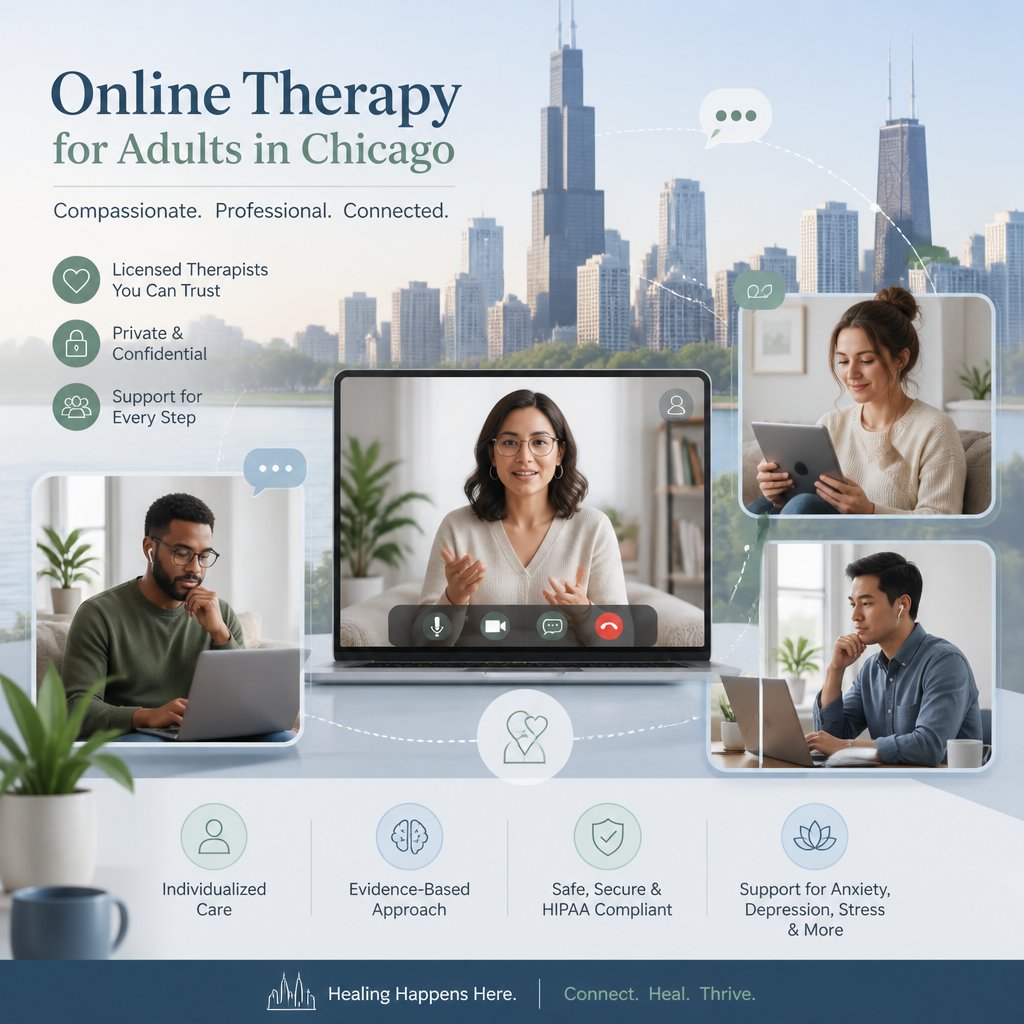
Living in Chicago, your schedule can feel like it’s never really yours. Long commutes, tough jobs, family stuff, and just the general city grind make it hard to find time for your mental health. That’s honestly why online therapy for adults in Chicago has become such a lifeline for so many people.
Virtual therapy gives you real, professional support—without turning it into another stressful errand. You can meet with a licensed therapist from your living room, your car, or wherever you feel comfortable and private. No need to lose an hour to traffic or circle for parking on the Kennedy.
Whether you’re wrestling with anxiety, burnout, relationship stress, or just that nagging feeling that something’s off, online counseling offers a flexible way to get the support you deserve. Let’s walk through what to expect, how to find the right therapist, and how to actually make virtual care work for your life.
Key Takeaways
- Online therapy lets you access quality mental health support from anywhere in Illinois, without disrupting your routine.
- Licensed therapists can help with everything from anxiety and depression to relationship issues and big life changes.
- Starting therapy doesn’t have to be overwhelming; small, practical steps can make it manageable right from the start.
How Virtual Sessions Work For Chicago Adults
Online therapy sessions are a lot like traditional in-person appointments. You connect with your therapist through a secure, HIPAA-compliant video platform. The conversation, the tools, and the relationship all translate surprisingly well to the virtual setting.
What A First Appointment Usually Feels Like
Your first session is usually just a conversation to get to know each other. Your therapist will ask what brought you in, a bit about your background, and what you’re hoping to get out of therapy. You don’t have to have it all figured out before you show up.
Most people feel a mix of nerves and relief in that first meeting. It’s normal to feel unsure about what to say or where to start. A good therapist will guide things gently and let you set the pace. By the end, you’ll probably have a better sense of whether the fit feels right and what working together might look like.
Who Online Care Can Support
Virtual therapy supports a wide range of adults. If you’re dealing with anxiety, depression, grief, burnout, trauma, or relationship stress, online sessions can really help. It’s also great for anyone facing big life shifts—career changes, divorce, loss, or becoming a parent.
Online care is especially useful if you:
- Have a demanding job with little flexibility
- Live far from therapy offices in Chicago
- Value the privacy of your own space
- Travel often or have a hectic routine
- Have health concerns that make commuting tough
When In-Person May Be A Better Fit
Virtual therapy isn’t right for every situation. If you’re in crisis, your symptoms feel severe, or you just can’t connect through a screen, in-person sessions might be better.
Some people simply open up more face-to-face. That’s a personal preference, and it’s completely valid. For Chicagoans, in-person therapy is still a strong option, and many practices offer both so you can switch if your needs change.
Common Reasons Adults Reach Out For Support
People come to therapy for all sorts of reasons—there’s no minimum requirement for what “counts.” Whether you’re feeling a vague sense that something’s off or you’re facing a specific crisis, therapy meets you where you are.
Anxiety, Depression, And Emotional Overwhelm
Anxiety and depression are two of the most common reasons adults start therapy. Maybe you notice constant worry, a low mood, trouble focusing, or just a heavy feeling that doesn’t really lift.
Emotional overwhelm might show up as snapping at people you love, crying for no obvious reason, or just feeling numb. These things are more common than most people realize, and they respond well to proven approaches like Cognitive Behavioral Therapy (CBT) and Acceptance and Commitment Therapy (ACT). Therapy gives you a space to make sense of what’s going on and learn skills that actually help.
Stress, Burnout, And Major Life Changes
Chicago’s pace can wear you down. Work pressure, money stress, caring for others, and the constant change can stack up until you feel drained in a way that sleep doesn’t fix.
Burnout isn’t just being tired. It’s a deeper kind of exhaustion that affects motivation, relationships, and even how you see yourself. Big life events—job loss, moving, breakups, loss—can also leave you feeling overwhelmed. Therapy gives you a place to slow down, sort through what you’re carrying, and figure out your next steps.
Relationship, Couples, And Family Concerns
Relationships can be both wonderful and really tough. Adults often reach out for help with communication struggles, repeating conflicts, intimacy issues, trust, or just the slow wear and tear of a long-term partnership.
Couples counseling and family therapy are available virtually, which makes it easier for everyone to join without the hassle of coordinating travel. Whether you’re trying to work through a conflict or just reconnect, therapy can help each person feel heard and understood.
Trauma Recovery, Self-Esteem, And Personal Growth
Not everyone comes to therapy because something’s wrong. Plenty of adults want to grow, heal from the past, or just understand themselves better.
Trauma work helps you process painful experiences in a safe, supported way—without having to relive everything. Self-esteem work focuses on that inner critic that says you’re not enough. Personal growth therapy helps you clarify your values, set goals, and build a life that feels more intentional. All of these are valid reasons to reach out.
Benefits Of Choosing Care From Home
Online therapy removes a lot of the practical barriers that keep people from getting support. For adults in Chicago, it’s often about time, logistics, and just finding a private space to focus on yourself.
Flexibility Around Work, Parenting, And Commuting
One of the biggest perks of virtual therapy is that it fits into your life instead of forcing you to rearrange everything. You can book a session during lunch, right after the kids leave for school, or in the evening—no commute needed.
For parents, caregivers, and anyone with a wild schedule, this flexibility is a game changer. You’re more likely to stick with therapy when you don’t have to plan around traffic on the 90 or 94.
Comfort, Privacy, And Ease Of Access
There’s something comforting about being in your own space for therapy. You can curl up on your couch, make tea, and settle in—no waiting room, no unfamiliar office.
Privacy is another big plus. You won’t bump into anyone you know, and you control your environment. For adults who feel self-conscious about seeking support, this can make starting much easier. Sessions use encrypted, HIPAA-compliant platforms, so your privacy is protected.
Consistency During Busy Or Unpredictable Weeks
Life in Chicago doesn’t pause when you need it to. If a blizzard hits, your child gets sick, or work runs late, getting to an office might be out of the question.
Online therapy helps you keep your routine, even when life gets messy. That consistency matters—progress in therapy builds over time, and missing sessions can slow things down. Virtual access helps you stay on track, even during chaotic weeks.
What To Look For In A Therapist
Finding the right therapist is huge. Credentials matter, but so does that gut feeling you get in your first conversation.
Licensing, Fit, And Areas Of Focus
Your therapist should be licensed to practice in Illinois. Common credentials include Licensed Clinical Social Worker (LCSW), Licensed Professional Counselor (LPC), Licensed Marriage and Family Therapist (LMFT), or psychologist (Ph.D. or Psy.D.). These show your provider has the right training and ethics.
But licensing isn’t everything. Look for someone whose focus matches your needs. If trauma is your main concern, find someone trained in trauma-informed care. If you want couples counseling, seek out relationship therapy experience. And trust your instincts about whether you feel comfortable with them—therapy just works better that way.
Approaches That Feel Evidence Based And Human
Good therapy uses approaches that research supports, but it should never feel like your therapist is reading from a textbook. Some common ones:
- Cognitive Behavioral Therapy (CBT): Helps you spot and change unhelpful thoughts
- Acceptance and Commitment Therapy (ACT): Builds flexibility and helps you live by your values
- Trauma-Informed Care: Understands how past experiences affect you now
- Mindfulness-Based Therapy: Uses awareness of the present moment to ease stress
- Emotionally Focused Therapy (EFT): Often for couples, to strengthen emotional bonds
What really matters is that your therapist uses these in a way that feels personal and responsive, not robotic.
Questions To Ask Before Booking
Before you commit, it’s totally okay to ask a few questions. Many practices offer a quick consultation call so you can get a feel for the fit before your first paid session.
You might ask:
- What’s your experience with [your concern]?
- Which approaches do you use?
- How do you usually structure sessions?
- What are your fees, and do you take my insurance?
- What’s your cancellation policy for online sessions?
These questions aren’t pushy—they show you’re serious about your mental health and want to make a good choice.
Virtual Vs In-Person Support In The Chicago Area
Both virtual and in-person therapy can genuinely help adults. The best fit depends on your needs, your schedule, and where you feel most comfortable opening up.
How To Decide Which Format Fits Best
Think about your real-life logistics. If you’ve got a 45-minute commute each way and always feel rushed, that stress can get in the way of therapy. Virtual sessions remove that hassle.
But if you live alone in a tiny apartment and crave in-person connection, office visits might help you engage more. There’s no one-size-fits-all answer. What matters is showing up regularly, feeling safe, and being able to talk honestly.
When A Hybrid Option Can Help
Some people find a mix of virtual and in-person sessions works best. Maybe you go in person during calmer weeks and switch to online when life gets busy.
A hybrid approach can help you build a strong relationship in person, then keep up momentum with virtual sessions. Not every practice offers this, so it’s worth asking about upfront.
How Tides Mental Health Supports Local Clients
Tides Mental Health offers both virtual and in-person therapy for adults in the Chicago area. The team works with people facing anxiety, depression, stress, burnout, relationship struggles, trauma, and life transitions, using proven approaches that fit your life.
Whether you want to start from home or sit across from someone face to face, Tides Mental Health is ready to meet you where you are.
Getting Started And Making Therapy Sustainable
Taking the first step doesn’t have to be a big production. Breaking things down into small, doable pieces makes starting therapy way less overwhelming.
Checking Insurance, Fees, And Scheduling
Before you book, take a few minutes to check your financial options. Call your insurance provider and ask if mental health and telehealth services are covered, what your copay or deductible looks like, and whether you need a referral.
Many Illinois therapists accept major plans like Blue Cross Blue Shield (BCBS) and Humana. If you’re paying out of pocket, sessions usually run from about $100 to $200+ depending on the therapist’s experience. Some offer a sliding scale for those with financial need, so don’t hesitate to ask.
Preparing Your Space For A Session
Let’s be honest—virtual therapy doesn’t require a fancy setup. What matters most is carving out a quiet, private spot where you won’t get interrupted for about 45 to 60 minutes. That’s really it.
A few things that help:
- Pop on headphones for better audio and a bit more privacy
- Shut down distracting browser tabs and mute your phone before you start
- Keep some water nearby—you’d be surprised how easy it is to forget to drink during tough conversations
- Give a quick heads-up to anyone at home that you’ll need some uninterrupted time
- Test your video and audio a few minutes ahead, just to avoid last-minute tech hiccups
Small Steps If You Feel Unsure About Beginning
Not sure if you’re ready? Honestly, that’s so normal. Most people feel a little uncertain about starting therapy. There’s no need to have it all figured out before you begin.
Maybe start by poking around—see what kinds of support are out there. Skim through some therapist bios and notice who feels approachable. Lots of practices have short, no-pressure intake forms you can fill out online. If there’s an option for a consultation call, go for it. Sometimes just taking one tiny step makes the next one less daunting.
Frequently Asked Questions
How do I choose the right online therapist for my needs?
First, think about what you’d like help with—maybe it’s anxiety, relationship stuff, past experiences, or something else entirely. Look for therapists who work with those concerns. Beyond that, focus on the human connection. You’ll usually get a sense in the first session or two if it feels like a good fit. Many practices offer a short consultation call before you book anything, which can make it easier to trust your gut.
Does my insurance cover online therapy sessions, and how do I check?
Just call the member services number on your insurance card and ask if your plan covers mental health and telehealth. Be sure to ask about copays, deductibles, and whether you need prior authorization. Major insurers in Illinois, like Blue Cross Blue Shield and Humana, usually cover virtual therapy the same way they do in-person sessions.
What does online therapy typically cost per session in my area?
In Chicago, most online therapy sessions cost between $100 and $200, depending on the therapist’s background and the type of practice. If you have mental health coverage, your out-of-pocket cost might be much lower. Fees can vary, so it’s worth checking directly with any therapist you’re considering.
Are there affordable online therapy options if I don’t have insurance?
Absolutely. Many therapists offer sliding scale fees based on your income—don’t hesitate to ask about it during a consultation call. Some community mental health organizations in Chicago also provide reduced-cost or income-based counseling for adults who need support but can’t pay standard rates.
How do online therapy appointments work, and what should I expect in the first session?
You’ll get a secure link to join your session on a HIPAA-compliant video platform—it’s a lot like any other video call. The first session is usually pretty relaxed: your therapist will get to know you, ask what brought you in, and start to understand your goals. You don’t need a clear plan or script; your therapist will help guide the conversation so it doesn’t feel overwhelming.
Are online therapists licensed to treat clients who live in Illinois?
Yes. Therapists offering online sessions to Illinois residents need an active Illinois state license. If you’re seeing someone based in Illinois—or even if they’re located elsewhere but licensed to practice in the state—you’re getting care under the same professional and ethical rules as in-person therapy. It’s a good idea to double-check that your therapist holds a current Illinois license before you start working together.