
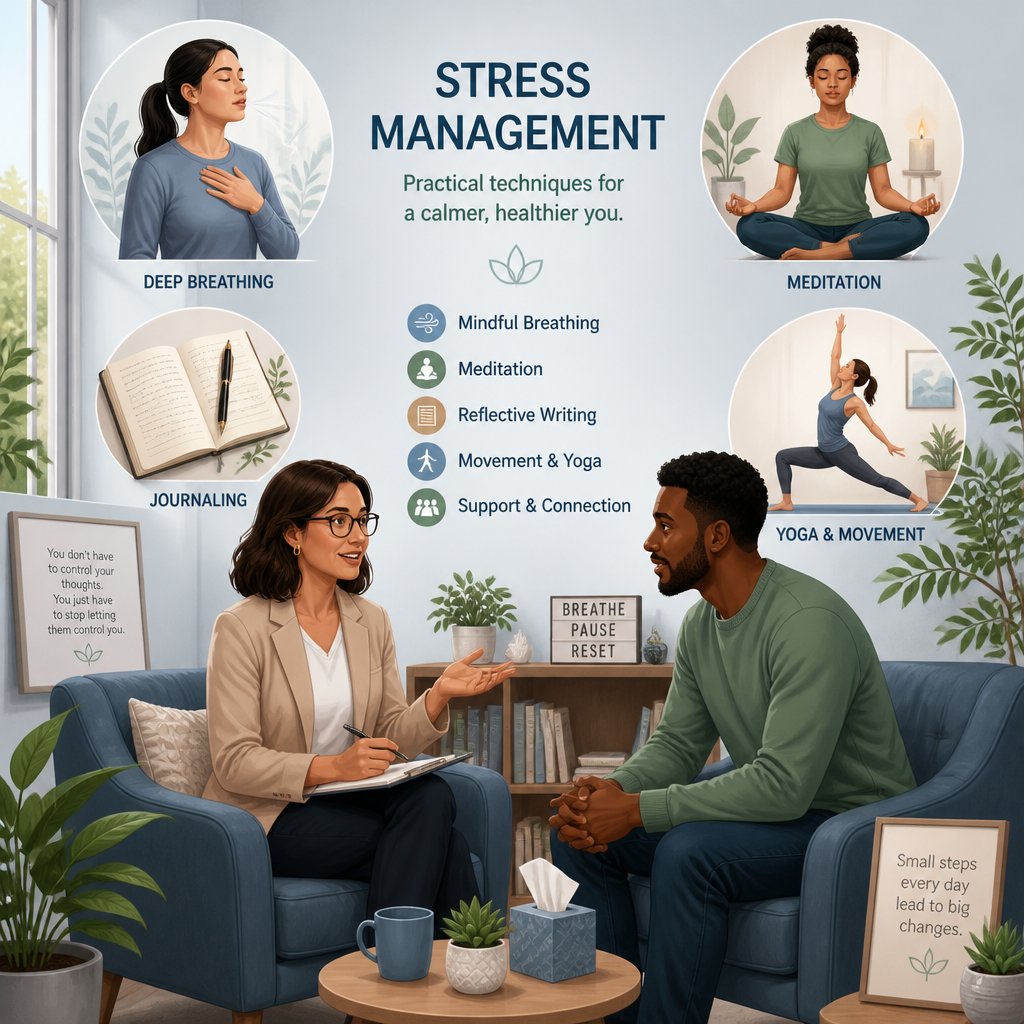
Stress has this sneaky way of working itself into nearly every part of life—messing with your sleep, your focus, your relationships, even how you see yourself from one day to the next. When it starts to feel less like a passing headache and more like a roommate you never wanted, it might be time to pay closer attention.
Therapy for stress management techniques isn’t just a list of tips. It’s a real, tailored plan for understanding your stress and learning how to respond to it in ways that actually help. With a mental health professional, you’ll start noticing your patterns, shift your thinking, and pick up practical skills that hold up in real life—not just on paper.
Let’s talk about what therapy for stress actually looks like, which approaches tend to work, and how you can build a plan that fits your actual life (not some perfect version of it).
Key Takeaways
- Noticing how stress shows up in your body and mind is the first step toward actually managing it.
- Approaches like CBT and mindfulness give you concrete tools to use both in and out of sessions.
- A sustainable plan blends professional support with daily habits that genuinely ease pressure over time.
How Therapy Helps With Stress Early On
Stress isn’t always obvious. Sometimes it’s just irritability, lousy sleep, trouble focusing, or a nagging sense of dread you can’t shake. Therapy can help you spot these early signs, figure out what’s driving them, and respond before things really spiral.
Signs Stress Is Affecting Daily Life
Your body and mind aren’t shy about sending up red flags when stress gets out of hand. Maybe little problems suddenly feel huge, or you snap at people you care about, or you just can’t drag yourself out of bed with any real motivation.
Other signs to look for:
- Struggling to fall asleep or stay asleep
- Finding it hard to concentrate at work or even during simple conversations
- Physical tension, headaches, stomach issues
- Pulling away from social things you used to enjoy
- Feeling emotionally drained for reasons you can’t quite name
None of this means you’re weak. It just means your nervous system is maxed out, and your mental well-being needs some care.
Acute Stress Vs. Chronic Stress
Stress isn’t all the same, and honestly, it helps to know the difference. Acute stress is the short-term kind—what you feel before a big meeting, a tough talk, or an unexpected curveball. Your stress response kicks in, you get through it, and things calm down.
Chronic stress is the kind that doesn’t let up. Maybe it’s nonstop work demands, money worries, relationship strain, or caregiving that never seems to end. Over time, chronic stress wears you down—physically, mentally, emotionally. It can mess with your sleep, your mood, and your ability to feel in control.
Therapy can be a game-changer when stress becomes part of your daily routine and your usual ways of coping just aren’t cutting it anymore.
When Stress Starts To Overlap With Anxiety Or Depression
Stress and anxiety can look similar, but there’s a difference. Stress usually has a clear source. Anxiety tends to stick around even when the original stressor is gone. When stress drags on, it can start to blend into anxiety or even depression.
Maybe you’re worrying constantly, even when things are calm. Or you lose interest in stuff you used to love, or you feel weighed down by hopelessness. These are signs that stress has crossed into territory where professional support can really help. Catching this early just makes it easier to get back on track.
What Stress Counseling Often Looks Like
Stress management therapy isn’t a cookie-cutter process. A good therapist will take the time to get to know your specific stressors, your history, your patterns, and what you actually want before building a plan with you.
How A Mental Health Professional Assesses Stress Patterns
Usually, your first meeting with a mental health professional is more conversation than checklist. They’ll ask about what’s been going on, how long you’ve felt this way, and how stress shows up for you—physically and emotionally.
They’re looking for patterns. Do you tend to catastrophize? Avoid tough situations? Struggle to set boundaries? Understanding these habits comes before any therapy techniques. It’s not about putting a label on you; it’s about getting a real, honest picture of what you’re dealing with.
Setting Goals For Stress Relief And Daily Functioning
Once your therapist has a sense of your stress patterns, you’ll set some realistic goals together. Maybe it’s getting better sleep, communicating more clearly with someone in your life, feeling less overwhelmed at work, or just learning to pause before reacting.
These goals are personal and practical. They’re about making your day-to-day life feel more manageable, grounded, and maybe even a little more hopeful.
Virtual And In-Person Support In The Chicago Area
One of the best changes in mental health care lately? Virtual therapy. If you’re in the Chicago area, you’ve got options now. Virtual sessions can fit into a busy schedule, cut out the commute, and make it easier to stick with therapy.
Of course, in-person care has its own strengths—some people really value that face-to-face connection, especially when things feel tough. Tides Mental Health offers both virtual and in-person sessions for adults in Chicago, so you can pick what actually works for you.
Evidence-Based Approaches Used In Sessions
The most effective stress therapy isn’t just guesswork. It’s built on methods that research backs up—cognitive tools and mindfulness practice are two of the big ones.
Cognitive Behavioral Therapy And Cognitive Restructuring
Cognitive behavioral therapy (CBT) is one of the most reliable approaches for managing stress. The basic idea: your thoughts, feelings, and behaviors are all connected. Change how you interpret a situation, and you can change how you feel and respond.
In CBT, you work with your therapist to spot thought patterns that make stress worse. Maybe you always assume the worst when things are uncertain. Cognitive restructuring helps you challenge those thoughts and swap them for something more balanced.
This is hands-on, practical work. You practice in sessions, then try it out in real life. Over time, it gets easier.
Mindfulness-Based Stress Reduction And Meditation
Mindfulness-based stress reduction (MBSR) is a structured program that blends mindfulness and meditation to help you relate to stress differently. Instead of fighting stressful thoughts, mindfulness teaches you to notice them without judging.
Regular mindfulness practice has been shown to lower cortisol, ease the stress response, and help with emotional regulation. In therapy, you might try short meditations, body scans, or breathing exercises you can use on your own.
Mindfulness isn’t about emptying your mind—honestly, who can do that? It’s about learning to be present without getting overwhelmed by what’s happening.
Cognitive Reframing For Overwhelming Thoughts
Cognitive reframing is a close cousin of cognitive restructuring, but it’s all about shifting perspective. When a thought feels overwhelming, reframing helps you see it from a new angle instead of taking it as absolute truth.
Say you catch yourself thinking, “I can never handle pressure.” A reframe could be, “I’ve gotten through tough stuff before, even when it felt impossible.” It’s not about fake positivity. It’s about building new mental habits that give you more options in stressful moments.
Therapists who know CBT and reframing can walk you through this in a way that feels doable, not forced.
Practical Skills You Can Use Between Appointments
The real magic of therapy happens between sessions, honestly. That’s when you’re out there facing actual stressors, trying out new skills, and seeing what really works for you.
Breathing Exercises And Box Breathing
Breathing exercises are about as accessible as it gets. When you’re stressed, your breath gets shallow and fast—your body thinks there’s a threat. Slow, deep breathing tells your nervous system it’s okay to stand down.
Box breathing is a simple method that works in the moment. Here’s how:
- Inhale slowly for 4 counts
- Hold for 4 counts
- Exhale slowly for 4 counts
- Hold for 4 counts
- Repeat 3 to 5 times
You can do this anywhere—at your desk, in traffic, lying awake at night. The more you practice, the more automatic it gets.
Progressive Muscle Relaxation And Deep Breathing
Progressive muscle relaxation is about tensing and releasing muscle groups one by one, so your body learns what relaxation actually feels like. A lot of us carry tension so long it just feels normal.
Pair it with deep breathing for extra impact. Start at your feet, tense for a few seconds, then release, and move up through your body. Many people find this especially calming before bed—it helps quiet both the physical tension and the mental noise.
Journaling, Visualization, And Guided Imagery
Journaling gives your stress somewhere to go. Just jotting down what you’re feeling, what happened in your day, or what’s bugging you can lighten the mental load. No need for perfect sentences—even five minutes can help you process and let go.
Visualization and guided imagery take a different route. Instead of analyzing your stress, these techniques invite you to picture calm, safety, or a positive outcome. Maybe you imagine a peaceful place in detail, using all your senses. It sounds simple, but your brain responds as if you’re actually there.
Regular use of these techniques can really lower the background tension you carry through the day.
Building A Sustainable Plan For Daily Life
Managing stress isn’t about getting rid of every stressor. It’s about building a life that can handle pressure without crumbling. A sustainable plan blends healthy habits, real relationships, and coping skills that fit your actual routine.
Time Management And Reducing Avoidable Pressure
A lot of daily stress comes from feeling like there’s too much to do and not enough time. While you can’t control everything, time management skills can ease some of the pressure.
Maybe that means setting clearer priorities, saying no more often, or breaking big tasks into smaller ones. When your expectations for the day are realistic, you leave space for both getting things done and actually recovering. Therapy can help you figure out where your time and energy are leaking away to avoidable stress.
Social Support, Self-Care, And Physical Activity
Your support network matters—a lot. Emotional support from friends, family, or any community can buffer stress. Loneliness, on the other hand, makes it worse. Making time for real connection isn’t just nice; it’s necessary.
Self-care—like getting enough sleep, eating well, and moving your body—directly affects how you handle stress. Physical activity, especially, can lower stress hormones and lift your mood. Yoga, for example, combines movement with mindfulness for a double benefit. Even creative hobbies or grounding rituals like aromatherapy can help some people find a bit of calm and reconnect with themselves.
Coping Mechanisms That Build Resilience
Not every coping strategy actually helps in the long run. Things like avoiding your problems or zoning out with screens or substances might give you a break for a bit, but they rarely help you bounce back stronger.
Healthier options? Try reaching out to someone when you’re struggling, leaning on breathing or grounding techniques you’ve practiced, or just pausing to ask yourself if you need a practical fix or some emotional space. With time, these habits can feel more natural. You don’t build resilience by pretending stress can’t touch you—it’s more about trusting that you can handle what comes your way and dial things down before stress takes over.
A therapist can help you take a good, honest look at how you’re coping now and help you put together a toolkit that actually fits your life and personality.
Knowing When To Reach Out For More Support
You don’t need to hit rock bottom before asking for help with stress. Therapy isn’t just for emergencies. It’s there for anyone who wants to handle stress better and feel a little more at ease in daily life.
When Stress Feels Unmanageable
If stress starts to feel like a constant background noise instead of something that comes and goes, it’s probably time to pay attention. Maybe your usual coping tricks aren’t cutting it, or you notice stress creeping into your sleep, your relationships, or how you show up at work or home.
Stress that just keeps piling up for months, or starts looking a lot like anxiety or depression, really deserves some outside support. You don’t have to wait until everything falls apart. Honestly, reaching out while you still have some energy to work with usually makes therapy more helpful.
Finding The Right Fit For Ongoing Care
Finding a therapist you actually feel comfortable with can make all the difference. It’s absolutely fine to have preferences—maybe you care about their communication style or how flexible they are with scheduling. The right fit should leave you feeling heard, respected, and sometimes gently nudged to grow.
If you’re in the Chicago area and want thoughtful, evidence-based support, Tides Mental Health works with adults on stress, burnout, anxiety, life changes, and more. They offer both virtual and in-person sessions, which helps if your schedule is all over the place.
Taking The First Step With Confidence
Reaching out for help with stress isn’t a sign that something’s wrong with you. It just means you’re paying attention to your own needs and want things to get better.
The first step can be as small as making a call or filling out a form. After that, a mental health professional will help guide you. You don’t have to have all the answers before you start. You just need to be willing to take that first step.
Frequently Asked Questions
What are five effective techniques to manage stress day to day?
Five practical techniques: deep breathing, journaling, progressive muscle relaxation, regular exercise, and mindfulness meditation. These don’t have to take a ton of time, and if you stick with them, they can really help lower your baseline stress. A therapist can help you figure out what mix actually fits your life.
What are some quick ways to relieve stress in the moment?
Box breathing works fast when stress hits out of nowhere. Grounding helps, too—try naming five things you see or hear. Even just stepping outside for a quick walk or tensing and relaxing your muscles can help you reset.
Which relaxation techniques work best for reducing stress?
Progressive muscle relaxation, guided imagery, and mindfulness-based practices all have solid research behind them. The right one for you depends on how stress shows up—maybe it’s more physical, or maybe it’s mostly in your head. A therapist can help you sort out what works best for you.
How can I reduce stress and anxiety immediately when I feel overwhelmed?
Start by slowing your breathing—shallow breaths make stress worse. Ground yourself by noticing your surroundings; name things you see or hear. If the overwhelm sticks around, it might be time to talk to a mental health professional about building a plan that works for you.
When should I consider seeing a therapist for stress management?
If stress has been messing with your sleep, relationships, focus, or physical health for a few weeks or more, it’s probably time to check in with a therapist. You really don’t have to wait for things to get bad. The sooner you get support, the sooner you’ll likely start feeling some relief.
What are 10 practical ways to cope with stress at home and work?
You’ve got options—box breathing can help calm your mind, and quick movement breaks shake off tension when you’re feeling stuck. Setting boundaries around your time (even if it feels awkward at first) protects your energy. Sometimes just jotting down your thoughts in a journal makes things feel less tangled. Reaching out to someone you trust, even for a short chat, can lighten the load.
Progressive muscle relaxation before bed helps your body unwind, while guided imagery during breaks gives your brain a mini vacation. Cutting back on caffeine (yeah, easier said than done) might actually help steady your nerves. Try sticking to a regular sleep routine, even on weekends. And if you can pinpoint your main stress triggers, you’re already halfway to dealing with them. No single trick fixes everything, but mixing a few of these into your daily routine can make stress feel a bit more manageable.