
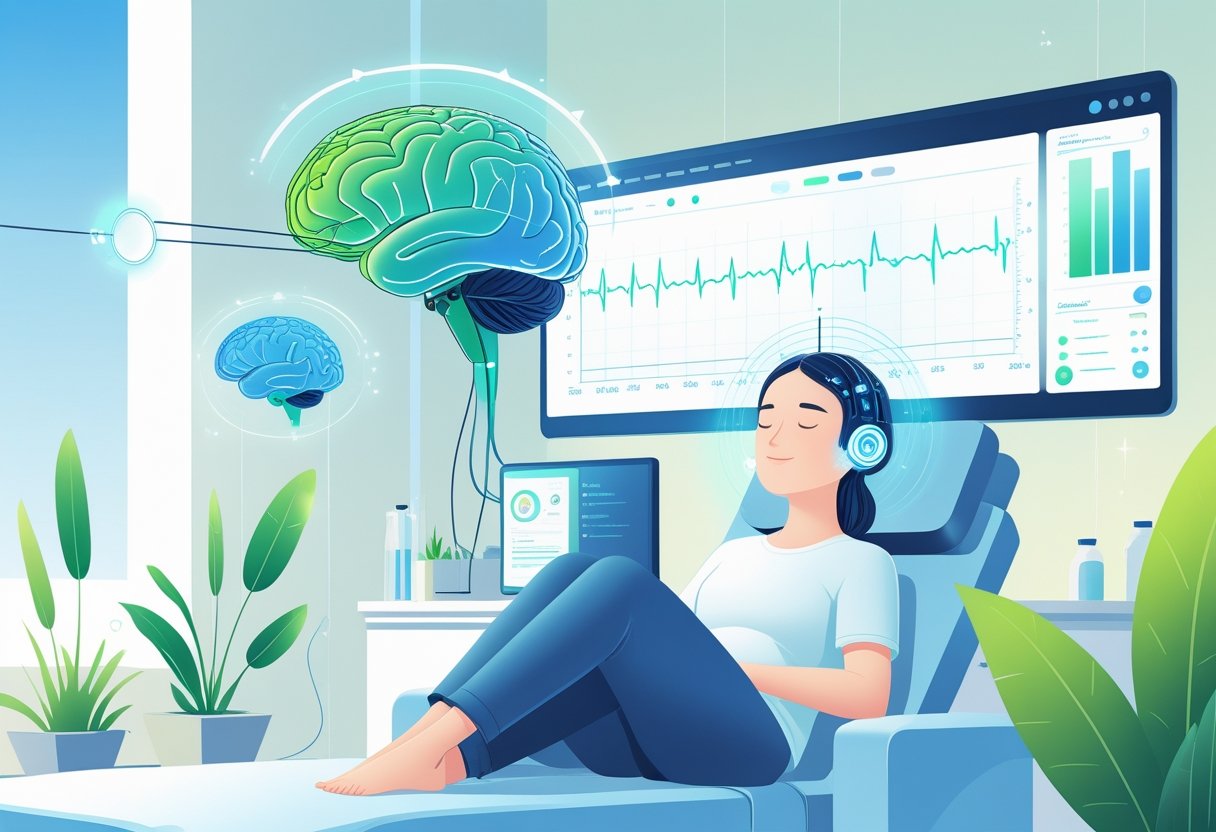
If anxiety feels like a constant hum you can’t switch off, neurofeedback therapy helps you learn to change the brain patterns behind those feelings. It uses real-time brainwave feedback so you can train your nervous system toward calmer, more steady states without medication.
Neurofeedback gives you a practical, non-invasive way to lower worry and improve focus by teaching your brain to produce more relaxed brainwaves. You’ll see how it works, who benefits, what to expect during sessions, and how tides mental health offers neurofeedback both virtually and in-person in the Chicago area.
What Is Neurofeedback Therapy for Anxiety?
Neurofeedback helps you change how your brain reacts to stress and worry by showing you real-time brain activity. You will learn to reduce high-arousal patterns and build calmer brain responses using repeated training sessions.
Definition of Neurofeedback
Neurofeedback is a noninvasive therapy that measures your brainwaves with sensors placed on the scalp. A computer translates those signals into visual or audio feedback you can see or hear in real time.
You practice changing your brain activity while you watch the feedback. The brain learns to shift toward healthier patterns over repeated sessions.
Sessions usually last 30–60 minutes. You sit quietly while the system rewards the brain for producing desired rhythms, like more alpha waves or fewer fast beta waves.
This operant conditioning approach aims to train lasting changes in how your brain self-regulates.
How Neurofeedback Relates to Anxiety
Anxiety often shows as excessive fast beta waves or irregular patterns in areas that manage threat and worry. Neurofeedback targets those patterns so you reduce automatic fight-or-flight responses.
Over time, your brain becomes better at calming itself when you face stressors. Training focuses on measurable changes, not only how you feel during a session.
Many people combine neurofeedback with therapy or skills training. At Tides Mental Health, you can access virtual sessions or in-person care in the Chicago area to pair neurofeedback with counseling for anxiety and related mood issues.
Types of Neurofeedback Used for Anxiety
- qEEG-guided neurofeedback: Uses a quantitative brain map to identify exact areas and frequencies linked to your anxiety. This data guides a tailored training plan.
- Frequency-based training (e.g., SMR/alpha/beta): Trains specific frequency bands. For anxiety, clinicians often aim to increase alpha or SMR and reduce excess fast beta.
- LORETA and sLORETA: Source-based methods target deeper brain regions by estimating where activity arises. These can help when surface training isn’t enough.
Most programs include 20–40 sessions, with progress tracked by repeated qEEG assessments and symptom measures. Tides Mental Health offers primarily virtual delivery (60–70%) and in-person options (30–40%) in Chicago, giving you flexible access to neurofeedback alongside therapy for anxiety and mood concerns.
How Neurofeedback Therapy Works
Neurofeedback shows you real-time brain activity, trains specific patterns, and teaches you to change them through feedback. The following subsections explain brainwaves, what happens during sessions, and how feedback helps you learn self-regulation.
Understanding Brainwave Activity
Brainwaves are electrical patterns your brain makes. They range from very slow (delta) to very fast (gamma).
For anxiety, clinicians often focus on alpha (relaxation) and beta (alertness) rhythms because imbalances in these bands can link to worry, hypervigilance, or difficulty calming down. An initial assessment records your EEG at rest and during simple tasks.
This map pinpoints which frequencies are overactive or underactive. Your clinician uses that map to set targets that encourage more balanced activity—for example, increasing alpha activity to support calm, or reducing high-beta to lower tension.
You receive clear numbers and visual graphs showing the unwanted patterns. Those data guide the training plan and let you and your clinician track progress over multiple sessions.
The Process of Neurofeedback Sessions
Sessions usually last 30–60 minutes and start with a quick check of your symptoms and goals. You sit comfortably while small sensors attach to your scalp with conductive paste.
The sensors record EEG signals with no shocks, medications, or direct brain stimulation. During training, you do simple tasks like watching a movie clip, playing a basic computer game, or listening to tones.
The software translates your brainwave patterns into feedback—if your brain moves toward the target pattern, the image stays clear or the music plays; if it drifts away, the image dims or sound reduces. You repeat this process for many short trials within a session.
The clinician adjusts thresholds and targets as you improve. Most people need multiple sessions—often 20–40—to see steady change, though some notice early shifts in sleep or anxiety.
Feedback and Self-Regulation
Feedback acts like a mirror for your brain. It gives immediate signals—visual, auditory, or both—when your brain produces the desired pattern.
That immediate link helps your nervous system learn which internal states match calm or focus. You do not actively “think” the right pattern.
Instead, your brain learns by reinforcement. Repeating successful responses strengthens those pathways, similar to how practice improves a skill.
Over time, those learned patterns become more automatic and show up outside sessions. Your clinician helps you generalize gains to daily life.
They pair neurofeedback with breathing strategies, sleep hygiene, or talk therapy to make results last. Tides Mental Health offers virtual and in-person neurofeedback as part of adult anxiety care, with in-person sessions available in the Chicago area.
Efficacy of Neurofeedback for Anxiety
Neurofeedback can lower anxious thoughts by training specific brainwave patterns. It often reduces symptom severity, improves sleep, and helps you gain better emotional control without adding medication.
Scientific Evidence and Research
Clinical studies show neurofeedback changes EEG patterns tied to anxiety. Randomized controlled trials and systematic reviews report improvements in generalized anxiety, social anxiety, and PTSD symptoms after several sessions.
Research often measures outcomes with standardized scales like the GAD-7 and PTSD checklists, which helps track symptom drops over time. Protocols vary: some target alpha/theta ratios, others reduce high-beta activity linked to hyperarousal.
Session counts in studies range from 10 to 40, with many showing steady improvement after 20 sessions. Studies note stronger results when neurofeedback combines with therapy, such as cognitive-behavioral approaches.
If you choose online care, most neurofeedback programs today offer virtual monitoring and coaching. Tides Mental Health provides adult-focused neurofeedback as part of a mixed virtual and Chicago-area in-person model, which fits the research trend toward blended delivery.
Success Rates and Outcomes
Success rates depend on protocol, clinician skill, and your commitment. Reviews report symptom reduction for 40–70% of participants across anxiety-related diagnoses.
Many patients report fewer panic attacks, calmer baseline mood, and better sleep within weeks to months. Outcomes improve when you attend regular sessions and practice learned self-regulation between visits.
Some people achieve lasting gains; others need booster sessions. Expect gradual progress rather than an immediate cure.
Tides Mental Health tracks outcomes with standardized scales so you can see measurable change during virtual or Chicago-area in-person care.
Comparison to Other Anxiety Treatments
Neurofeedback is noninvasive and drug-free compared with medications, which can work faster but may have side effects. Compared with psychotherapy alone, neurofeedback can speed up reductions in physiological arousal and help you learn self-regulation skills more directly.
Combined treatment—neurofeedback plus therapy—often yields better results than either alone in studies. If you prefer mostly virtual care, neurofeedback integrates well with online therapy sessions.
Tides Mental Health offers both neurofeedback and counseling, so you can try combined or single‑modality plans based on your needs and location.
Who Can Benefit from Neurofeedback Therapy
Neurofeedback can help people who want non-drug ways to reduce anxiety, improve sleep, or sharpen focus. It works well with talk therapy and can fit into short- or long-term plans depending on your goals.
Suitable Candidates
You may be a good candidate if you are an adult dealing with persistent anxiety that interferes with work, sleep, or relationships. People who try medication or talk therapy but still feel anxious often see benefits from adding neurofeedback.
If you have trouble with concentration, chronic worry, or physical symptoms like tension and sleep problems tied to anxiety, neurofeedback can target brain patterns linked to those issues. Tides Mental Health offers neurofeedback as part of adult therapy services, mainly via virtual sessions for convenience.
If you prefer in-person care, options are available at our Chicago location. Neurofeedback also suits those willing to track progress across multiple sessions and combine training with counseling.
Common Anxiety Disorders Treated
Neurofeedback can help several anxiety diagnoses by training brain activity tied to stress and arousal. It often supports treatment for generalized anxiety disorder (GAD) by reducing constant worry and restlessness.
People with panic disorder may use neurofeedback to lower the brain’s tendency to react with sudden fear and to reduce the frequency of panic attacks. Social anxiety can respond to neurofeedback by improving regulation of stress responses during social situations.
When anxiety comes with insomnia or attention problems, neurofeedback can target those linked brainwave patterns to improve sleep and focus alongside therapy.
The Neurofeedback Therapy Experience
Neurofeedback sessions use sensors to read your brain activity and give real-time feedback so you can learn to change unhelpful patterns. You will work with a clinician who guides the process, tracks progress, and adjusts settings to target anxiety symptoms.
What to Expect in a Session
A clinician will place small EEG sensors on your scalp to record brainwaves. You sit comfortably while the system shows visual or audio feedback—like a game, movie, or tones—that changes when your brain produces the desired activity.
You stay awake and alert the whole time. The clinician watches your brain patterns and may adjust thresholds or give brief coaching between runs.
Most sessions include several 3–10 minute training runs with short breaks. You may feel relaxed, mildly tired, or notice small shifts in focus after a session.
Side effects are usually minimal. Tides Mental Health offers virtual and in-person options in Chicago, so you can choose what fits your schedule.
Duration and Frequency of Treatment
Clinicians commonly recommend 20–40 sessions for measurable change. Many people start with two sessions per week for the first 6–12 weeks to build learning, then reduce to once weekly or biweekly for maintenance.
Individual plans depend on your symptoms, response rate, and goals. Clinicians at Tides Mental Health assess progress regularly and adjust the plan.
Costs, scheduling, and whether you use virtual or in-person sessions (Chicago-area for in-person) will also affect how long your course lasts.
Potential Side Effects and Considerations
Neurofeedback can change how your brain responds to stress and worry, but it may also cause short-lived reactions. Pay attention to how you feel during and after sessions, and tell your clinician about any new or worsening symptoms.
Risks and Safety
Some people feel tired, dizzy, or get headaches after a session. These effects usually last hours to a day as your brain adjusts.
A small number report increased anxiety, sleep trouble, or mood swings right after training. Serious or lasting problems are rare, but they can happen if training is not tailored to your brain patterns.
Always work with a licensed clinician who monitors your EEG data and adjusts protocols. Tell your provider about medications, seizures, or a history of bipolar disorder, since those can change risk.
If you get stronger or longer symptoms, stop sessions and contact your clinician. Tides Mental Health offers both virtual and Chicago-area in-person follow-up to help manage side effects and adapt your plan.
Factors Influencing Effectiveness
Your baseline anxiety type, sleep quality, and medications affect how well neurofeedback works. Generalized anxiety, panic, and social anxiety can respond differently; clinicians choose protocols to target your specific patterns.
Session frequency and total number matter. Common plans use 20–40 sessions with regular progress checks.
Consistent sleep, reduced caffeine, and concurrent therapy or medication usually improve results. Provider skill and equipment quality also shape outcomes.
Choose a trained clinician who reviews EEG results and personalizes training. Tides Mental Health offers licensed practitioners and mixed virtual/in-person care to fit your schedule and treatment needs.
Choosing a Neurofeedback Practitioner
Finding the right practitioner matters for safe, effective neurofeedback that targets your anxiety. Look for clear credentials, practical experience with anxiety treatment, and a provider who explains the process, risks, and expected outcomes.
Qualifications and Credentials
Look for a licensed mental health professional—such as a psychologist, LCSW, or LPC—who also has specific training in EEG neurofeedback. Certification from recognized neurofeedback organizations (for example BCIA) shows formal training in EEG theory, safety, and protocols.
Ask whether the practitioner uses clinical-grade EEG equipment rather than consumer headbands. Check how many hours they have overseen neurofeedback sessions and whether they have experience treating adult anxiety.
Prefer providers who document baseline assessments, individualized protocol planning, and ongoing outcome tracking. Verify malpractice insurance and state licensure.
If you want some sessions in person, know that in-person options are available in the Chicago area. Many providers, including Tides Mental Health, offer both virtual and in-person care.
Questions to Ask Providers
Ask these specific questions before you start: What are your licensure and neurofeedback certifications? How many anxiety-specific cases have you treated and what were the typical outcomes?
What EEG system do you use and do you provide raw data or session summaries? Clarify logistics: session length, frequency, estimated number of sessions, costs, and cancellation policy.
Ask how they integrate neurofeedback with therapy for anxiety, such as CBT or skills training. Request references or case summaries (de-identified) and ask how they measure progress.
Finally, ask about safety: possible side effects, contraindications, and what steps they take if you feel worse after a session.
Cost and Accessibility of Neurofeedback Therapy
Neurofeedback costs vary by location, provider, and session type. You can expect choices between single sessions, package deals, virtual training, and in-person visits in the Chicago area.
Typical Costs and Insurance Coverage
Session prices commonly range from $75 to $200, with many clinics charging about $100–$200 per visit. Providers often offer discounts for packages of 10 or more sessions, which reduces the per-session price.
Some clinics rent home-training equipment or sell starter kits that change upfront cost but cut long-term expenses. Insurance coverage is inconsistent.
Many plans do not cover neurofeedback as a standard benefit, though HSA/FSA funds often apply. You should call your insurer and ask about mental health coverage, specific CPT codes, and whether preauthorization or a therapist’s referral helps.
Tides Mental Health accepts many payment methods and can help you check benefits and set up payment plans.
Availability in Different Regions
If you live near Chicago, you can access in-person neurofeedback at Tides Mental Health clinics. These locations provide assessment, brain-mapping options, and follow-up care tailored to anxiety, depression, life transitions, and couples or family work.
In-person slots tend to be limited, so scheduling ahead helps. If you live farther away, virtual neurofeedback makes therapy more accessible.
About 60–70% of services run virtually, letting you train at home with remote clinician support. Expect a mix of video sessions and remote device monitoring.
Tides Mental Health plans to expand child and adolescent services in the future while keeping adult-focused care as the core offering.
Future Directions in Neurofeedback for Anxiety
Neurofeedback research is growing, and you may see more tailored treatments soon. Clinicians aim to match training protocols to your specific anxiety patterns and co-occurring issues like depression or life transitions.
More studies will compare neurofeedback to standard therapies and test combined approaches. You might receive neurofeedback alongside cognitive-behavioral therapy, medication, or couples and family counseling to improve outcomes.
Technology will make sessions more accessible to you. Expect improved home-capable systems and secure virtual coaching.
Currently about 60–70% of care happens online, with 30–40% in person. If you prefer an in-person option, Tides Mental Health offers Chicago-area clinics where you can get hands-on care.
Researchers will refine biomarkers to track progress and predict who benefits most. That means shorter, more efficient treatment plans and clearer goals you can follow, especially during life changes.
Clinical programs plan to expand services to younger clients. Right now, most offerings focus on adult therapy and counseling, but future services will include child and adolescent options so families can access targeted care.
If you choose neurofeedback, look for providers who blend evidence-based methods with clear tracking of your symptoms. Tides Mental Health can help you explore both virtual and Chicago-based in-person neurofeedback as part of a broader anxiety care plan.