
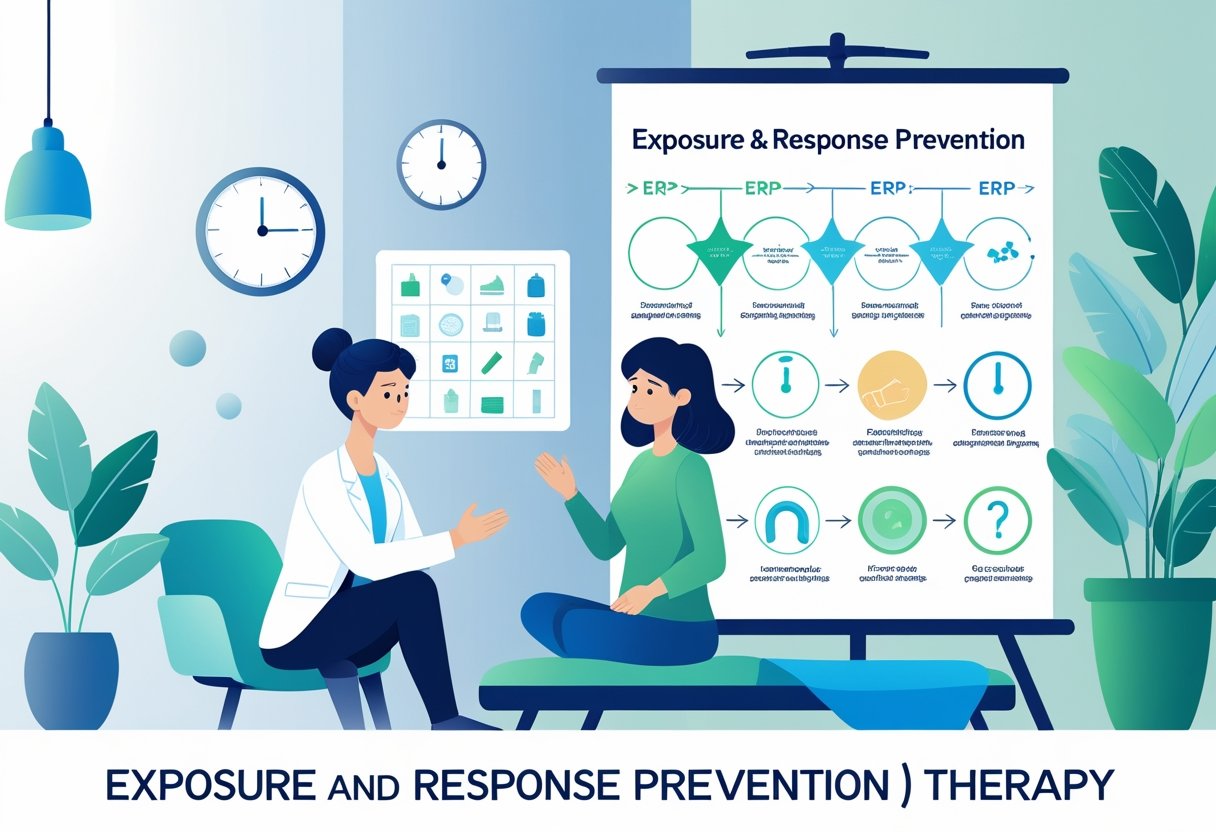
Exposure and response prevention (ERP) therapy helps you face the thoughts, places, or actions that trigger anxiety. It teaches you to resist the urge to perform rituals that only make anxiety worse.
ERP works by guiding you to slowly confront fears while preventing the usual responses. Over time, your anxiety decreases and your life becomes less controlled by rituals.
You will learn how exposures are planned, practiced, and scaled so they stay safe and effective. The article will explain how ERP treats conditions like OCD and anxiety, what a typical ERP process looks like, and what to expect in virtual or in-person sessions with Tides Mental Health in the Chicago area.
Overview of Exposure and Response Prevention Therapy
Exposure and Response Prevention (ERP) helps you face anxiety triggers and learn to resist the urge to perform rituals. It focuses on real-life situations and step-by-step practice.
ERP changes how your brain learns fear so symptoms drop over time.
Definition of Exposure and Response Prevention
ERP is a focused form of cognitive behavioral therapy that asks you to intentionally confront the thoughts, images, objects, or situations that cause your obsessive fears. During exposure, you experience the anxiety-provoking stimulus without doing the compulsive behavior you usually use to reduce distress.
Over repeated practice, the anxiety decreases through a process called habituation and through learning that feared outcomes are unlikely. A typical ERP plan uses a ranked list of triggers, from least to most distressing.
Sessions mix guided exposures with coaching on how to tolerate urges. You’ll practice both in therapy and between sessions to build real-world skills.
Core Principles of ERP
ERP rests on three practical rules: face feared situations, prevent ritual responses, and repeat exposures. Facing feared situations reduces avoidance and shows your brain that anxiety falls on its own.
Preventing rituals stops the short-term relief that keeps obsessions and compulsions tied together. Therapists help you create a hierarchy of triggers and teach coping strategies such as breathing and urge-surfing.
Progress comes from repeated, planned practice. Tides Mental Health offers ERP via mostly virtual sessions and in-person care in the Chicago area.
History and Development
ERP evolved from behavior therapy research in the mid-20th century that showed exposure reduced phobias. Clinicians combined exposure with response prevention when they noticed compulsive rituals undermined long-term improvement.
Over decades, controlled studies established ERP as the first-line, evidence-based treatment for obsessive-compulsive disorder. Researchers refined techniques like imaginal exposure, in vivo exposure, and graded hierarchies.
Training moved into clinical programs and specialty clinics. Today ERP is widely used in adult anxiety treatment.
You can access ERP through Tides Mental Health’s clinicians trained in these proven methods.
How Exposure and Response Prevention Therapy Works
ERP helps you face anxiety triggers and avoid ritual responses so your fear fades with repeated practice. It uses step-by-step exposure and planned strategies to stop compulsions.
A therapist guides and coaches you through the process.
Exposure Process
ERP builds a list of situations, thoughts, or images that trigger your anxiety. You and your therapist rank each item by how much distress it causes, from mild to intense.
Then you work through the list in small steps, starting with items that cause moderate anxiety. During each exposure, you remain in the feared situation until your anxiety drops on its own.
Repeating exposures weakens the link between the trigger and the fear response. You may practice exposures in session or between sessions at home, depending on the plan you and your therapist agree on.
Your brain learns new information: the feared outcome often does not happen, or you can tolerate the discomfort. This learning reduces the urge to perform rituals over time.
Response Prevention Techniques
Response prevention means you intentionally avoid rituals or safety behaviors after an exposure. You use specific tactics like delaying a compulsion, doing a partial ritual-free task, or practicing alternative coping skills.
You track urges, note how long they last, and record how anxiety changes without performing the ritual. This data helps you see progress and adjust strategies.
Common tools include breathing exercises, grounding techniques, and brief distraction when urges peak. The goal is to let anxiety fall naturally, so the need for rituals weakens and your confidence grows.
The Role of the Therapist
Your therapist creates the exposure hierarchy and models how to do exposures safely. They coach you through exposures, help you stay present when urges arise, and teach response-prevention skills.
They monitor progress, adjust difficulty, and provide feedback after each practice. In virtual sessions, your therapist can guide exposures in your real environment.
In-person work is available in the Chicago area for hands-on support. Your therapist will help you apply skills to everyday situations and plan for setbacks.
Conditions Treated With ERP
ERP treats problems that cause repeated fear-driven thoughts and rituals. It helps you learn new, less avoidant ways to respond.
Many people see big drops in ritual behavior and anxiety after working through targeted exposures with a trained clinician.
Obsessive-Compulsive Disorder
ERP is the first-line treatment for OCD. You will face the thoughts, images, or urges that trigger you and practice not doing the rituals that usually follow.
Sessions start with a hierarchy of triggers ranked by distress. You expose yourself to lower-risk items first, then move up as your anxiety drops.
Therapists teach response prevention so you stop neutralizing the fear with compulsions. Over time your brain learns that anxiety decreases on its own.
This reduces the urge to check, wash, count, or repeat rituals. Tides Mental Health offers ERP-focused treatment both virtually and in-person in the Chicago area if you want guided, structured care.
Other Anxiety Disorders
ERP helps several anxiety disorders by targeting avoidance and safety behaviors. For specific phobias, you directly face the feared object or situation in gradual steps.
For social anxiety, exposures include speaking or eating in front of others while resisting safety moves like rehearsing or avoiding eye contact. Panic disorder responds when you deliberately trigger mild bodily sensations so you learn they are not dangerous.
Trauma-related avoidance can also improve when you safely revisit avoided memories or places. You can access most ERP work virtually, with about 60–70% of Tides Mental Health sessions offered online to fit your schedule.
Related Behavioral Conditions
ERP adapts well to conditions that share compulsive or ritual patterns. For example, it helps with some eating disorder rituals, body-focused repetitive behaviors (like hair-pulling or skin-picking), and compulsive checking linked to health anxiety.
Treatment targets the specific ritual and the urge that drives it. Therapists use behavioral experiments and response prevention tailored to your behavior.
They also address any co-occurring depression or life transition stress that keeps the rituals active. In-person ERP is available through Tides Mental Health’s Chicago clinics.
Steps in the ERP Process
ERP breaks treatment into clear steps you can follow. You will start with an assessment, make a ranked plan of fears, and then practice exposures that stop compulsions.
Assessment and Planning
You and a clinician review your symptoms, triggers, and current rituals. The clinician asks about how often your urges occur, how long they last, and what you do to reduce anxiety.
You may fill out questionnaires and track episodes for a week so the clinician can measure progress. The clinician also checks for other issues like depression, safety concerns, or medication needs.
Together you set goals that are specific and measurable, such as reducing hand‑washing to a set number of times per day. If you prefer virtual sessions, Tides Mental Health offers remote options; in‑person care is available in the Chicago area.
A clear plan defines session frequency, homework expectations, and rules for preventing compulsions. The therapist explains how exposures work and how you will stop rituals during and after exposure.
Developing the Exposure Hierarchy
You list situations, thoughts, or objects that trigger your anxiety and rate each by how much distress it causes on a 0–100 scale. Start with items that cause low to moderate distress.
The hierarchy might include touching a doorknob (30), reading a feared thought aloud (55), then deliberately using a public restroom (80). Your therapist helps break big tasks into smaller steps so each exposure is achievable.
They prioritize items that will give the most benefit for the least risk. You agree on specific exposures, how long each will last, and how you will prevent compulsive responses during them.
The hierarchy is flexible. You move up when you can face a step without using rituals and your distress drops.
If a step feels too hard, the clinician adjusts the level or adds intermediate steps to keep progress steady.
Gradual Exposure Exercises
You perform exposures starting with lower‑rated items and work upward. During an exposure, you intentionally face the feared trigger and resist the urge to do the compulsion.
Sessions may begin in therapy and then shift to guided homework you practice between appointments. Exposures vary by type: in vivo (real situations), imaginal (detailed imagining), and interoceptive (physical sensations).
Each exposure lists a goal, a time frame, and a clear rule about which behaviors you will not use. You measure anxiety levels before, during, and after to see reduction over time.
Homework and tracking are crucial. You log each exposure, note how long you resisted compulsions, and record your anxiety ratings.
Your therapist reviews these logs and adjusts the plan. Tides Mental Health supports both virtual and Chicago‑area in‑person sessions to guide you through these exercises.
Effectiveness of Exposure and Response Prevention
ERP helps you face feared thoughts and stop rituals. It reduces distress, lowers compulsion frequency, and improves daily functioning for most people who try it.
Results from Clinical Studies
Many clinical trials show ERP outperforms relaxation, supportive therapy, and medication alone for OCD symptoms. Studies often measure change with standardized scales like the Yale-Brown Obsessive Compulsive Scale (Y-BOCS).
Trials report large symptom drops after 12–20 sessions when patients follow therapist-guided exposure hierarchies and refuse rituals. Researchers found ERP effective in both individual and group formats.
Virtual delivery produces similar short-term gains when sessions follow the same structure. Trials also track improvements in anxiety, daily functioning, and quality of life.
You tend to see faster change when you practice exposures between sessions and when a therapist helps tailor exposures to your real-life triggers.
Long-Term Outcomes
Follow-up studies show many people keep symptom reductions for months to years after completing ERP. Maintenance depends on continued practice of exposure techniques and occasional booster sessions.
When you stop rituals and face triggers repeatedly, new learning consolidates and relapse risk falls. Some people have partial return of symptoms, especially under stress or life changes.
In such cases, targeted booster sessions — offered virtually or in-person in the Chicago area by Tides Mental Health — can restore gains. Your chance of long-term benefit rises if you engage in homework, involve family when needed, and get care that fits your schedule (about 60–70% virtual, 30–40% in-person).
Success Rates
Across meta-analyses and trials, ERP helps a large majority of people reduce OCD symptoms. Typical estimates show around 60–80% of patients experience significant symptom relief.
Recovery and remission rates vary by study, but many report about one-third reach near-remission levels after a full course of ERP. Success depends on factors you can influence: severity at start, presence of depression, willingness to do exposures, and treatment fidelity.
If you want ERP, Tides Mental Health offers structured programs and flexible virtual or Chicago-based in-person options to match your needs.
Benefits of Exposure and Response Prevention Therapy
ERP helps you face anxiety triggers and stop rituals. It teaches clear skills you can use in daily life to reduce distress and regain control.
Improved Symptom Management
ERP reduces how often and how strongly intrusive thoughts and urges lead to compulsive actions. You will practice controlled exposures to specific triggers—like contamination fears, checking, or intrusive thoughts—while learning to resist performing rituals.
Over repeated sessions, your anxiety drops faster without rituals. Situations that once felt unbearable become manageable.
This therapy also lowers avoidance. You will slowly return to activities you once avoided, such as using public restrooms, touching doorknobs, or leaving the house.
Many people report fewer hours spent on rituals. This allows for more time for work, relationships, and hobbies.
Tides Mental Health offers ERP in both virtual (60–70% of sessions) and in-person formats (Chicago area). This means you can get consistent, practical symptom relief in a way that fits your life.
Empowerment and Coping Skills
ERP gives you skills you can use long after therapy ends. You learn to identify triggers, rate anxiety levels, and apply stepwise exposures.
These steps make fear more predictable and less overwhelming. You also build coping tools to handle setbacks.
Techniques include breathing, grounding, and realistic self-talk that reduce panic during exposures. Therapists at Tides Mental Health coach you to plan exposures, track progress, and handle slips without returning to old rituals.
These skills transfer to other problems too—managing general anxiety, depression, life changes, and relationship stress. You gain confidence in facing hard situations and a clear plan to keep improving.
Challenges and Considerations
ERP can be highly effective, but it demands commitment, careful planning, and the right fit between you and the therapist. Expect practical barriers, strong short-term discomfort, and differences in how people respond to the treatment.
Barriers to Success
Cost, scheduling, and access often block consistent ERP work. If you need frequent sessions, virtual care can help.
Tides Mental Health offers 60–70% virtual options and in-person care in Chicago to reduce travel and time burdens. Insurance limits or high copays can still slow progress, so check coverage before starting.
Therapist experience matters. Look for clinicians trained in ERP and in treating adults with anxiety, OCD, or related issues.
Poorly guided exposures can reinforce fears rather than reduce them. Also, life demands — work, caregiving, or school — can interrupt homework and between-session practice that ERP requires.
Motivation and support affect outcomes. If you avoid exposures or skip response prevention, gains stall.
Consider involving family or a partner in planning to reduce misunderstandings and help maintain practice.
Managing Discomfort
ERP intentionally brings up anxiety. Expect spikes in panic, intrusive thoughts, or physical symptoms at first.
Your therapist will build a step-by-step plan so you face triggers gradually and safely. You’ll practice sitting with discomfort instead of using rituals or safety behaviors.
Use concrete coping tools: breathing techniques, grounding exercises, and short behavioral experiments. These tools reduce distress enough to continue exposures without reverting to rituals.
Track your anxiety levels before, during, and after exposures to see real progress over weeks. If the distress becomes overwhelming or triggers severe depression or self-harm thoughts, pause and contact your clinician immediately.
Tides Mental Health clinicians can adjust pacing, add medication consultation, or shift to more supportive strategies until you stabilize.
Suitability for Different Individuals
ERP fits many adults but is not the right first step for everyone. If you have active suicidal thoughts, unmanaged substance use, or severe cognitive impairment, your clinician may treat those issues first.
ERP also needs you to tolerate short-term anxiety and do homework between sessions. People with neurodiversity, complex trauma, or strong avoidance patterns may need modified ERP.
A clinician experienced with these populations can adapt exposures, use more structure, or combine ERP with other therapies. For couples or family dynamics that maintain rituals, including family sessions can speed change.
If you’re unsure whether ERP suits you, ask for an assessment focused on your current symptoms, safety, and daily responsibilities. Tides Mental Health offers evaluations that consider virtual or Chicago-based in-person options to find the right approach for your situation.
ERP in Different Settings
ERP can fit into many therapy formats. You’ll see it delivered one-on-one or in groups, and either face-to-face or online.
Each format changes how you practice exposures, track progress, and get support.
Individual vs. Group Therapy
Individual ERP gives you a tailored plan that matches your fears, rituals, and pace. Your therapist builds a hierarchy of exposures just for you and watches your response closely.
That lets them adjust homework, teach coping skills, and prevent safety behaviors that slow progress. Group ERP adds peer support and real-time practice with others who share similar challenges.
You’ll do exposures in front of the group, get feedback, and learn from others’ strategies. Groups can lower cost and increase accountability, but they may move at a set pace and offer less one-on-one tailoring than individual work.
Tides Mental Health offers both options so you can choose what fits your needs. If social support helps you face feared situations, group ERP may work well.
If you need specific, intense work on particular rituals or complex co-occurring issues like depression or relationship stress, individual ERP usually serves you better.
In-Person and Online Formats
In-person ERP in Chicago lets you do exposures in real settings — stores, transit stops, or messy rooms — with your therapist nearby. That direct support helps when exposures are intense and you need immediate coaching.
In-person also works well for couples or family sessions where dynamics matter. Online ERP gives you more flexibility and a chance to do exposures in your daily environment.
You can work on triggers at home while the therapist coaches via video. Currently, about 60–70% of sessions at Tides Mental Health are virtual, which makes treatment easier to fit into your schedule and helps you practice real-world tasks between sessions.
Both formats use the same ERP principles: graded exposure, response prevention, and homework. Your choice should match the exposures you need, your comfort with technology, and whether in-person visits in Chicago are practical for you.
Finding a Qualified ERP Therapist
Look for a therapist who lists Exposure and Response Prevention (ERP) as a specific skill. You want someone who has training in ERP or CBT for OCD and anxiety.
Ask about their experience treating adults with anxiety, depression, and life transitions. Check whether the therapist uses online or in-person sessions.
Many providers now offer mostly virtual care. Aim for someone who can meet your needs about 60–70% virtually and 30–40% in person.
If you prefer face-to-face visits, in-person options are available in the Chicago area.
Ask these key questions:
- How long have you used ERP with clients?
- What training or certifications do you have in ERP?
- How do you structure exposures and track progress?
Verify practical details before you start. Confirm session length, fees, insurance use, and cancellation policies.
Also ask about plans for expanding to child and adolescent therapy if you may need family care later.
Consider Tides Mental Health as an option when you’re ready to book care. They provide adult-focused therapy for anxiety, depression, life changes, and couples or family work, with a mix of virtual and Chicago-area in-person appointments.