
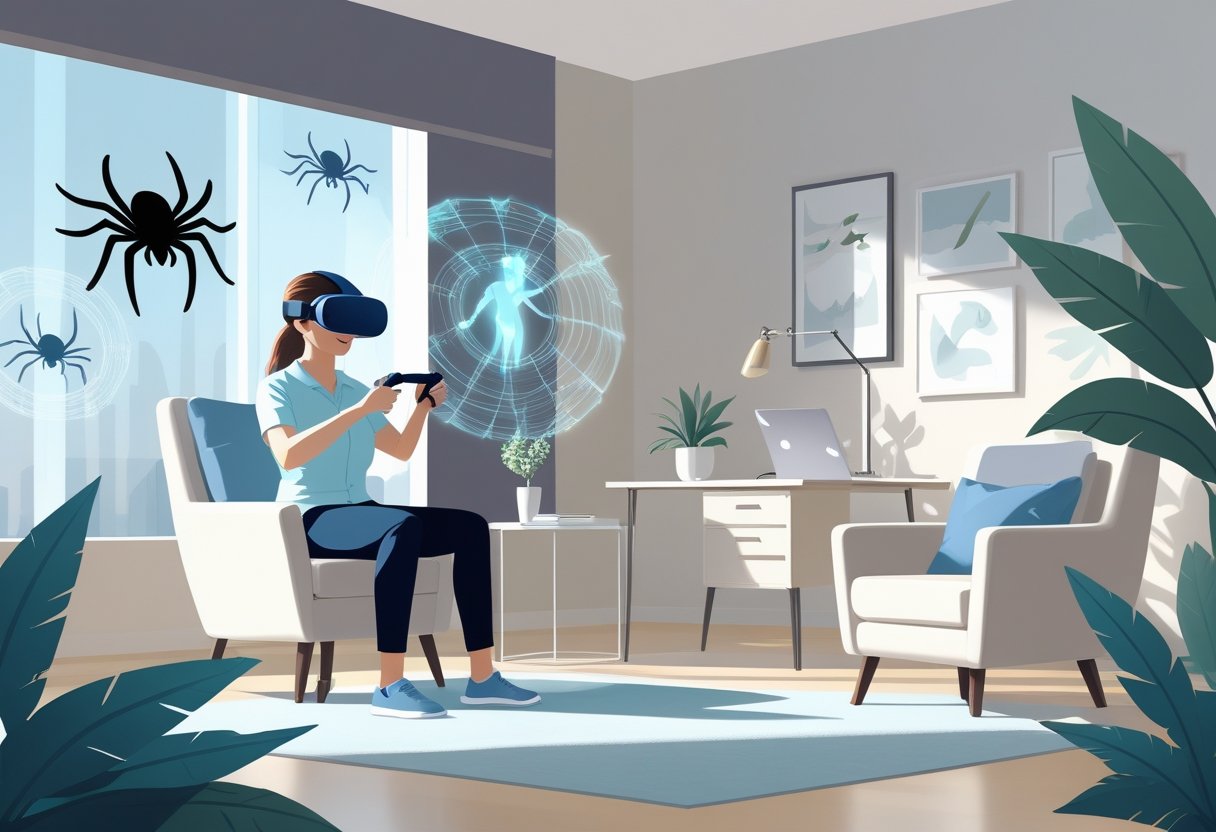
You may feel stuck avoiding things that make your heart race or palms sweat. Virtual reality exposure therapy (VRET) lets you face those situations in a safe, controlled virtual space while a therapist guides the process, making real change possible without risky real-world setups.
VRET often works as well as traditional exposure therapy and can make treatment easier to access, tailor, and tolerate for many people with phobias.
This article will show how VRET works, which fears it helps, and what to expect if you try it through a clinician like Tides Mental Health, whether virtually or at our Chicago office.
You’ll learn the benefits, limits, and how VRET compares to standard treatments so you can decide if it fits your path to feeling calmer and more in control.
What Is Virtual Reality Exposure Therapy?
Virtual reality exposure therapy uses VR headsets and software to place you in controlled, realistic situations that trigger fear.
It helps you face those situations safely, practice coping skills, and reduce avoidance over time.
How Virtual Reality Is Used in Therapy
Therapists guide you while you wear a headset that recreates feared settings—like a crowded train, flying, heights, or social situations.
You can control intensity: start with low-stress scenes and graduate to harder ones as you gain confidence.
Sessions combine exposure with breathing, grounding, and cognitive strategies that the therapist teaches in real time.
Tides Mental Health offers VRET during virtual sessions and in-person appointments in the Chicago area.
Most clients receive therapy virtually, but you can also meet in person when needed.
Core Principles of Exposure Therapy
Exposure therapy rests on repeated, safe contact with feared cues until your anxiety decreases.
You learn that the feared outcome is unlikely or manageable.
Therapists use graded steps, clear goals, and measurable progress—tracking avoidance, heart rate, or subjective anxiety on each visit.
In VRET, these same principles apply but with precise control over triggers.
Your therapist adjusts scenarios and guides coping practice.
This method works with other treatments like cognitive restructuring and relaxation training.
Advancements in Virtual Reality Technology
Recent VR systems deliver higher visual fidelity, spatial audio, and motion tracking, which makes scenarios feel more real and effective.
Software now customizes scenes to specific phobias and logs your responses for progress review.
Some platforms integrate biofeedback to show your heart rate and breathing during exposure.
At Tides Mental Health, our VR tools connect with teletherapy sessions so your therapist can change scenarios live.
This technology helps you get consistent, repeatable exposures whether you meet virtually or at our Chicago clinic.
How Virtual Reality Exposure Therapy Treats Phobias
Virtual reality exposure therapy (VRET) helps you face fears in a controlled, repeatable way.
It uses graded exposure, therapist guidance, and adjustable scenarios to reduce avoidance and lower anxiety over time.
Mechanisms Behind Phobia Treatment
VRET works by gradually exposing you to fear triggers while keeping safety and control.
Repeated exposure weakens the link between the trigger and the panic response.
Your brain learns the situation is not as dangerous as it felt before.
Therapists also use cognitive techniques during VR sessions to challenge negative thoughts.
You practice coping skills like breathing and grounding while the fear is present.
Over time, these skills become automatic and reduce panic.
Physiological responses shift too.
Heart rate and sweating decrease with repeated sessions, showing your body stops treating the stimulus as a threat.
That change supports lasting reductions in avoidance and distress.
Step-by-Step Process for Patients
First, you meet with a therapist to identify your specific fear and set clear goals.
The therapist explains how VRET works and gets your consent.
They may use virtual scenes for heights, flying, public speaking, or small animals.
Next, you try a low-intensity scene while the therapist coaches you through breathing and thought-reframing.
Sessions increase in difficulty only when you tolerate the current level.
Each session lasts 30–60 minutes and repeats exposure until anxiety drops.
Your therapist tracks your progress and adjusts scenarios to focus on the hardest moments.
You also get homework — practicing coping skills outside VR.
Tides Mental Health offers these VR options with mostly virtual sessions and in-person care in Chicago.
Role of Realism and Customization
Realism matters because believable stimuli trigger real anxiety, which lets you practice coping under realistic conditions.
High-quality visuals, spatial audio, and interactive elements improve immersion and better simulate real-life situations.
Customization lets the therapist tailor scenes to your exact needs.
They can change intensity, add specific cues, or create combinations of triggers that match what you fear most.
This precision shortens treatment time and boosts effectiveness.
Therapists can pause, rewind, or repeat moments so you learn to handle peak anxiety.
You stay in control: you can stop or step back if it becomes too intense.
That balance of realism and therapist control makes VRET both powerful and safe.
Types of Phobias Treated With Virtual Reality Exposure Therapy
VR exposure lets you face fears in a safe, controlled setting.
You can practice coping skills and repeat scenarios until anxiety drops.
Specific Phobias Addressed
Virtual reality works well for specific, focused fears like flying, heights, spiders, needles, and confined spaces.
In VR, you can slowly increase exposure — for example, moving from a distant airplane cabin to a full takeoff — while your therapist guides breathing and grounding techniques.
Sessions let you pause, change intensity, and repeat situations more easily than real-life exposure.
You get repeated, graded practice without real danger.
That makes VR a practical option if travel, cost, or safety make in vivo exposure hard.
Tides Mental Health offers virtual sessions that follow these steps and can pair VR with cognitive strategies.
Social Phobias and Public Speaking
VR recreates social scenes such as small group conversations, crowded parties, or a stage for public speaking.
You can rehearse introductions, handle interruptions, or deliver a speech to an audience that you control.
Therapists coach you on cognitive restructuring and behavioral experiments while you remain in the virtual scenario.
This method helps you build confidence before trying real events.
Since many therapy sessions are virtual, you can work on social anxiety from home and then shift to in-person practice at our Chicago clinic when you’re ready.
Agoraphobia and Related Conditions
For agoraphobia and panic-related avoidance, VR simulates environments that trigger fear: crowded malls, public transit, or busy streets.
You practice entering these spaces gradually, learning breathing and grounding skills during exposure.
Therapists track progress and adjust scenarios to match your pace.
VR exposure reduces avoidance by giving you a controlled path to face feared places.
You can start in online sessions and transition to in-person steps at Tides Mental Health’s Chicago location when your therapist recommends real-world practice.
Benefits of Virtual Reality Exposure Therapy
Virtual reality exposure therapy gives you precise, repeatable ways to face specific fears.
It makes sessions safer, more engaging, and lets you and your therapist track real progress with data you can use.
Enhanced Safety and Control
VRET lets you face feared situations without real-world risk.
Your therapist can set the scene—like heights, flying, or crowded places—and adjust intensity step by step.
If anxiety spikes, they can pause or lower the exposure immediately.
You stay in a clinic or on a secure telehealth call while the environment changes around you.
That controlled setting protects you from physical danger, reduces logistical barriers, and makes it easier to practice exposures you might avoid in real life.
This approach also lets the therapist tailor exposures to what triggers you most.
They can repeat exact scenarios across sessions to build tolerance and confidence, while keeping you physically safe and emotionally monitored.
Increased Patient Engagement
Immersive VR feels real enough to provoke meaningful emotional responses, which helps you practice coping skills under the same stress you experience outside therapy.
The realism often makes exposures less abstract than imagining a scene or doing talk-only exercises.
You typically find sessions more motivating when you can see and interact with simulation elements.
That leads to better attendance and more consistent practice between sessions.
Tides Mental Health offers both virtual sessions and in-person therapy in Chicago, giving you flexible access to VRET within the care model you prefer.
Because VRET blends exposure with clear goals and immediate feedback, many people report faster buy-in and more active learning during treatment.
Measuring Progress Effectively
VRET provides objective ways to track how you respond over time.
Therapists can record measures like heart rate, subjective anxiety ratings, and task performance within the simulation.
Those data points help you and your therapist see real change instead of relying only on memory.
You can compare responses to the same scenario across sessions to spot improvements or adjust the plan.
This makes therapy more transparent: you know which situations are improving and which need more work.
Using these measurements, your therapist can fine-tune session length, intensity, and homework.
That targeted approach helps you move toward your goals steadily and efficiently.
Limitations and Challenges
VR exposure therapy can cause physical discomfort, need complex hardware, and face barriers to access in real-world clinics.
You should weigh side effects, technical limits, and whether local in-person support fits your needs.
Potential Side Effects
Some people feel nausea, dizziness, or headaches during or after VR sessions.
These symptoms, often called cybersickness, occur when visual motion does not match inner-ear signals.
Sessions that move too quickly, high visual contrast, or long exposure increase risk.
VR can also trigger strong emotional reactions.
You might experience intense anxiety, panic, or intrusive memories when confronting phobic scenes.
Therapists must monitor your response and use gradual exposure and grounding techniques to reduce risk.
Rarely, VR can worsen sleep or cause lingering headache for a day.
If you have a history of seizures, vestibular disorders, or severe motion sickness, tell your clinician before using VR.
Tides Mental Health offers screening and both virtual and Chicago-based in-person care to manage these risks.
Technical Barriers
High-quality VR needs capable headsets, controllers, and software that can simulate realistic scenarios.
Poor graphics, latency, or tracking drift lower immersion and reduce therapy effectiveness.
Older or low-cost hardware may not support the precise cues therapists need.
Software updates and interoperability issues can interrupt sessions.
You might lose progress or face compatibility problems between devices.
Therapists need training to run sessions smoothly, adjust settings, and troubleshoot in real time.
Bandwidth and reliable internet matter for guided remote sessions.
If your home connection lags, the experience may stutter or disconnect.
Tides Mental Health provides guidance on minimum system specs and can schedule in-person Chicago sessions when technical limits block effective VR therapy.
Accessibility Concerns
Cost creates a major barrier.
High-end headsets and therapeutic software can be expensive to buy or rent.
Insurance coverage for VR therapy remains inconsistent, so out-of-pocket costs may be significant for some patients.
Physical and sensory limits reduce access for some people.
Those with severe visual impairment, limited neck mobility, or chronic pain may not tolerate headsets.
Language, cognitive differences, and low tech literacy also limit who can benefit without extra support.
Geography and clinic availability matter.
If you live outside the Chicago area or lack broadband, in-person options may be hard to reach.
Tides Mental Health offers virtual-first care (about 60–70% online) and in-person services in Chicago to help bridge location and tech gaps.
Comparison With Traditional Exposure Therapy
Virtual reality exposure therapy (VRET) lets you face feared situations in a controlled digital space, while traditional in-vivo exposure places you directly in real-world settings.
Both aim to reduce fear through repeated, safe exposure.
The next parts explain how results compare and how the patient experience differs so you can decide which fits your needs.
Effectiveness and Outcomes
Research shows VRET often matches in-vivo exposure for common phobias like flying, heights, and spiders. Studies report similar reductions in fear and avoidance after a course of therapy.
Some trials find VRET slightly better for patients who avoid real situations, because you can start exposures sooner and adjust intensity precisely. For complex or very specific phobias, in-vivo exposure can sometimes produce faster generalization to real life.
Combining VRET with occasional real-world practice tends to improve long-term gains. If you want measurable steps, VRET gives repeatable scenarios and built-in tracking.
Tides Mental Health offers both virtual sessions and Chicago-based in-person options to match your goals.
Patient Experience Differences
You will often feel safer starting with VRET because the environment is clearly simulated and fully controllable. That lowers refusal and dropout rates for people who dread direct contact with the feared stimulus.
Sessions tend to be more predictable, which helps you progress without unexpected setbacks. In-vivo exposure can feel more challenging but may boost confidence by proving you can handle real situations.
It also exposes you to real sensory cues that some virtual systems can’t yet reproduce. At Tides Mental Health you can begin with virtual work remotely—matching the clinic’s 60–70% virtual model.
You can move to in-person sessions in Chicago when you’re ready to practice real-world skills.
Future Directions for Virtual Reality Exposure Therapy
Virtual reality exposure therapy will keep improving with better hardware and smarter therapy blends. You will see more realistic experiences, new sensors, and ways to combine VR with other treatments for stronger results.
Emerging Technologies
New VR headsets offer higher resolution, wider fields of view, and lower latency, which reduce nausea and make exposures feel more real. Haptic devices and hand-tracking let you interact with virtual objects, so flying, heights, or social scenarios respond to your movements.
Biometric sensors—heart rate, skin conductance, and eye tracking—can feed real-time data to the therapist. That data helps adjust the scene intensity to match your anxiety level.
Cloud-based platforms let therapists load custom scenarios and update them quickly. This supports remote sessions for most clients while keeping some in-person visits in Chicago when needed.
Tides Mental Health can provide both virtual and in-person VR options to fit your needs.
Integration With Other Treatments
Pairing VR exposure with cognitive-behavioral techniques strengthens learning. Your therapist can pause a scene to teach breathing or cognitive reframing.
They can then resume exposure to practice coping skills in the same moment. Combining VR with brief meds or relaxation training can make early sessions more tolerable for high-anxiety clients.
VR also supports multi-modal care. You can track your progress with digital homework and use teletherapy follow-ups.
Treatment plans often mix about 60–70% virtual work with 30–40% face-to-face visits, tailored to your comfort and symptom severity. Tides Mental Health offers integrated plans that follow this balance and expand services into adolescent care as needed.