
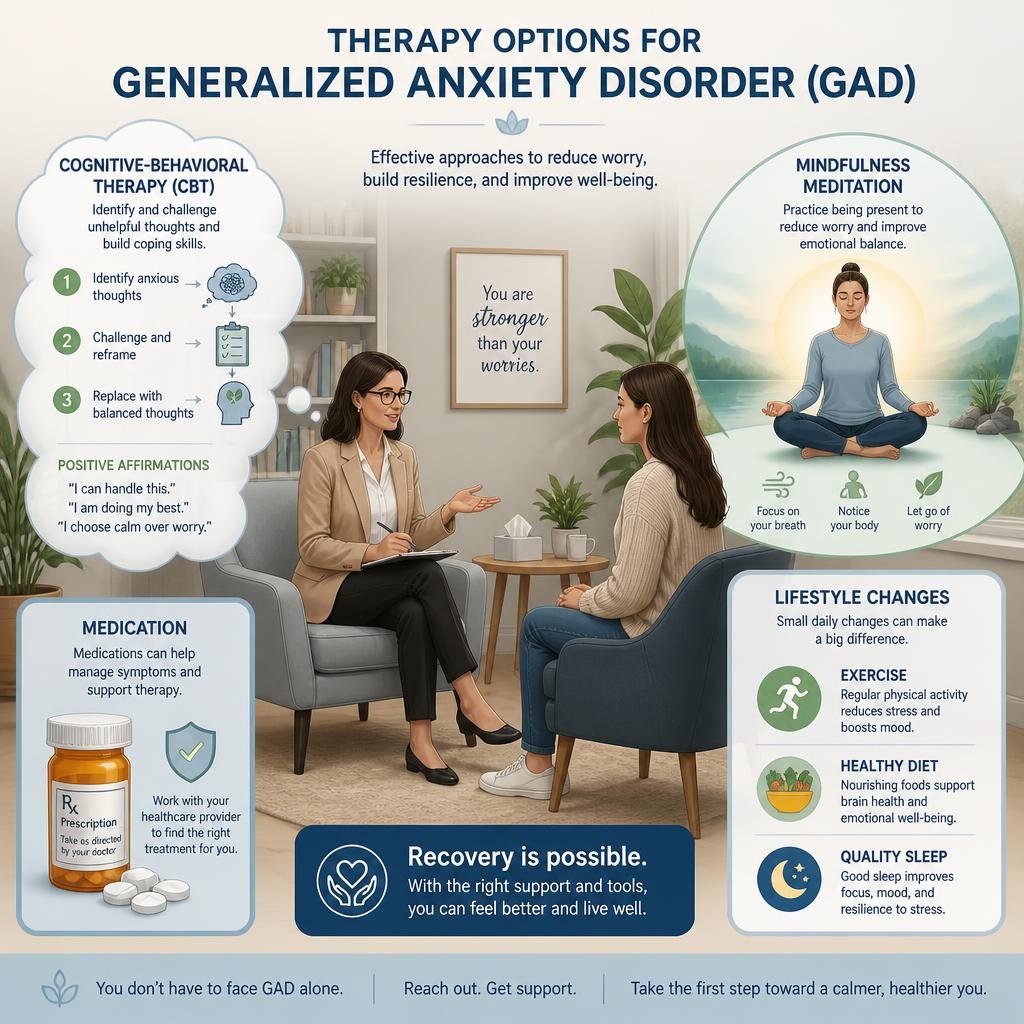
Therapy for generalized anxiety disorder can help you move from constant worry to a steadier daily routine. If you live with generalized anxiety disorder, or GAD, you may notice that your mind keeps scanning for problems, even when nothing urgent is happening.
That pattern can wear down sleep, focus, relationships, and confidence.
The most effective gad treatment usually combines a clear therapy plan, practical coping skills, and, for some people, medication support. When treatment for gad is matched to your symptoms and life situation, you have a better chance of reducing anxiety symptoms and improving your quality of life.
GAD is more than stress. It often shows up as ongoing worry, physical tension, and a sense that your mind never gets to rest.
Good therapy for anxiety gives you tools to work with those patterns in a direct, structured way.
How Therapy Helps Generalized Anxiety Disorder
Generalized anxiety disorder affects both thoughts and the body. You may expect the worst, replay decisions, or feel tense without a clear reason.
Therapy helps you spot the pattern, slow it down, and replace it with skills you can use in real life.
What GAD Looks Like In Daily Life
In daily life, GAD can look like overchecking messages, avoiding decisions, or spending hours thinking through small risks. Common anxiety symptoms include restlessness, fatigue, irritability, and muscle tension, along with trouble sleeping or concentrating.
People with GAD often describe pathological worry, which means the worry feels hard to stop and hard to control. It can show up at work, at home, in relationships, and during quiet moments when your mind should be resting.
How Therapy Targets Worry And Intrusive Thoughts
Therapy gives you a way to test anxious thoughts instead of treating them as facts. It also helps you notice intrusive thoughts without getting pulled into long worry loops.
A mental health professional can help you name triggers, track patterns, and build skills to manage anxiety more directly. Over time, that can reduce how often worry drives your choices.
When GAD Overlaps With Anxiety And Depression
GAD often appears with anxiety and depression at the same time. That comorbidity can make symptoms feel heavier, since low mood, hopelessness, and worry can reinforce each other.
Therapy can address both the anxious thinking and the loss of energy or motivation that often comes with depression.
CBT As A First-Line Therapy For GAD
Cognitive behavioral therapy is the most studied approach for GAD, and it is widely used as a first-line treatment for gad. It focuses on the connection between thoughts, feelings, body reactions, and behavior, which makes it practical and goal-directed.
Why CBT Is Often Recommended First
CBT, also called cognitive behavior therapy or cognitive-behavioral therapy, is a form of psychotherapy and talk therapy that has strong support in research. A recent review in Expert Review of Neurotherapeutics found that CBT is efficacious for GAD and can lead to meaningful symptom improvement.
That same review notes that CBT helps many people, though not everyone responds the same way.
Core CBT Techniques For GAD
A standard cbt for gad plan often includes self-monitoring, cognitive restructuring, and behavioral therapy tools. You learn to track worry, notice interpretation bias, and challenge negative interpretation before it drives more anxiety.
Therapists may also work on attention control and intolerance of uncertainty. These skills help you stay with the present moment instead of treating every unknown as a threat.
Common tools include:
- self-monitoring of worry and triggers
- cognitive therapy to test anxious predictions
- cbt techniques for behavior change
- exposure to uncertainty in small steps
- relaxation and breathing work when body tension is high
What Research Says About CBT Outcomes
Research from randomized controlled trials and meta-analysis studies shows that CBT can improve treatment outcomes for GAD. One review found remission rates around 51% after treatment and about 65% at follow-up, which shows that gains can hold over time.
Researchers often use tools like the PSWQ and GAD-7 to track symptom change. Those measures help show whether your worry is easing and where more work is needed.
Other Evidence-Based Therapy Approaches
CBT is not the only useful option. Other therapy approaches can fit your needs if you prefer a different style, if CBT has not worked well before, or if your symptoms connect strongly to values, emotions, or relationships.
Acceptance And Commitment Therapy
Acceptance and commitment therapy, or ACT, focuses on acceptance, values, and action. Instead of trying to eliminate every anxious thought, you learn to make room for discomfort while still moving toward what matters to you.
This can help if worry keeps you stuck in avoidance. ACT often pairs well with mindfulness because both support a steadier response to anxious thoughts.
Mindfulness And Relaxation-Based Approaches
Mindfulness and meditation can help you notice anxiety without reacting to it right away. Relaxation techniques such as applied relaxation, progressive muscle relaxation, and the relaxation response can lower physical tension and support sleep.
These methods are often used alongside talk therapy rather than alone. Self-control desensitization may also be used in some treatment plans to reduce fear responses over time.
Interpersonal And Emotion-Focused Therapies
Interpersonal therapy, or IPT, may help when anxiety is tied to conflict, role changes, or relationship stress. Emotion-focused therapy, or EFT, can strengthen emotion regulation and emotion regulation skills when feelings are hard to name or manage.
These approaches can be useful if your anxiety rises during life transitions, family stress, or couples counseling needs.
Medication And Combined Treatment
For some people, therapy works best with medication as part of a combined treatment plan. This is common when symptoms are intense, long-lasting, or getting in the way of work, sleep, or relationships.
When Medication May Be Added To Therapy
Medication may be added when therapy alone is not enough, when anxiety symptoms are severe, or when depression is also present. A mental health professional or prescriber can help decide whether therapy and medication together make sense for your treatment plan.
Combined treatment can be especially useful when worry is constant and physical symptoms are strong.
Common Medications Used For GAD
Common medication options include antidepressants, especially SSRIs and SNRIs. Examples include escitalopram, paroxetine, sertraline, duloxetine, venlafaxine, Prozac, and Zoloft.
Buspirone may also be considered for some people. Benzodiazepines are sometimes used short term, though they are usually approached with caution because of sedation and dependence risk.
Benefits And Risks To Discuss With A Prescriber
Medication can ease anxiety enough to make therapy more effective. It can also help if sleep, appetite, or concentration have slipped.
At the same time, side effects matter. You should talk through sedation, dependence risk, timing, and what to do if a medicine does not fit your needs.
Building A Personalized GAD Treatment Plan
A good treatment plan should fit your symptoms, schedule, and goals. The best gad treatment is the one you can actually use in daily life.
Choosing The Right Type Of Support
Your plan may include therapy for anxiety, medication, or combined treatment. A mental health professional can help match the approach to your main concerns, whether that is work stress, family strain, panic about health, or constant worry about the future.
At Tides Mental Health, adult therapy and counseling can be tailored to anxiety, depression, life transitions, and couples or family concerns, with virtual and in-person support available in the Chicago area.
Lifestyle Changes That Support Therapy
Lifestyle changes can strengthen therapy results. Regular exercise, mindfulness, meditation, relaxation techniques, and problem-solving habits often help lower baseline tension.
Small routines matter. Better sleep habits, less caffeine, and scheduled downtime can support your ability to manage anxiety between sessions.
How Virtual And In-Person Therapy Can Fit Your Needs
Virtual therapy can be a strong fit if your schedule is full or travel is hard. In-person sessions can help if you focus better face to face or want a more structured setting.
Many people use a mix of both. If you want flexible care, Tides Mental Health currently offers mostly virtual sessions with in-person options in the Chicago area.
When To Seek Support And What Progress Can Look Like
It is a good idea to seek support when worry feels constant, sleep is affected, or your daily life is shrinking around anxiety. Early care can reduce the chance that symptoms become more entrenched.
Signs It Is Time To Start Therapy
You may want psychotherapy or talk therapy if you are avoiding decisions, overchecking, or losing time to worry. It also helps to reach out when anxiety is causing work problems, relationship strain, or physical tension that does not ease.
If symptoms have lasted for months, or if depression is also present, a mental health professional can help you decide on next steps. NAMI also offers useful information on anxiety disorders and support.
What To Expect In Early Sessions
Early sessions usually focus on your symptoms, stressors, and goals. Your therapist may use tools like the GAD-7 or PSWQ to measure where you are starting from and to track changes over time.
You may also build a simple plan for coping between visits. That often includes tracking worry, practicing skills, and noticing what situations trigger the strongest anxiety.
Long-Term Progress, Maintenance, And Relapse Prevention
Progress often looks gradual. You may still feel anxiety, while seeing less time lost to worry, fewer physical symptoms, and better quality of life.
Maintenance work helps you keep gains after symptoms improve. A solid GAD treatment plan includes relapse prevention, so you know what to do if worry starts building again.