
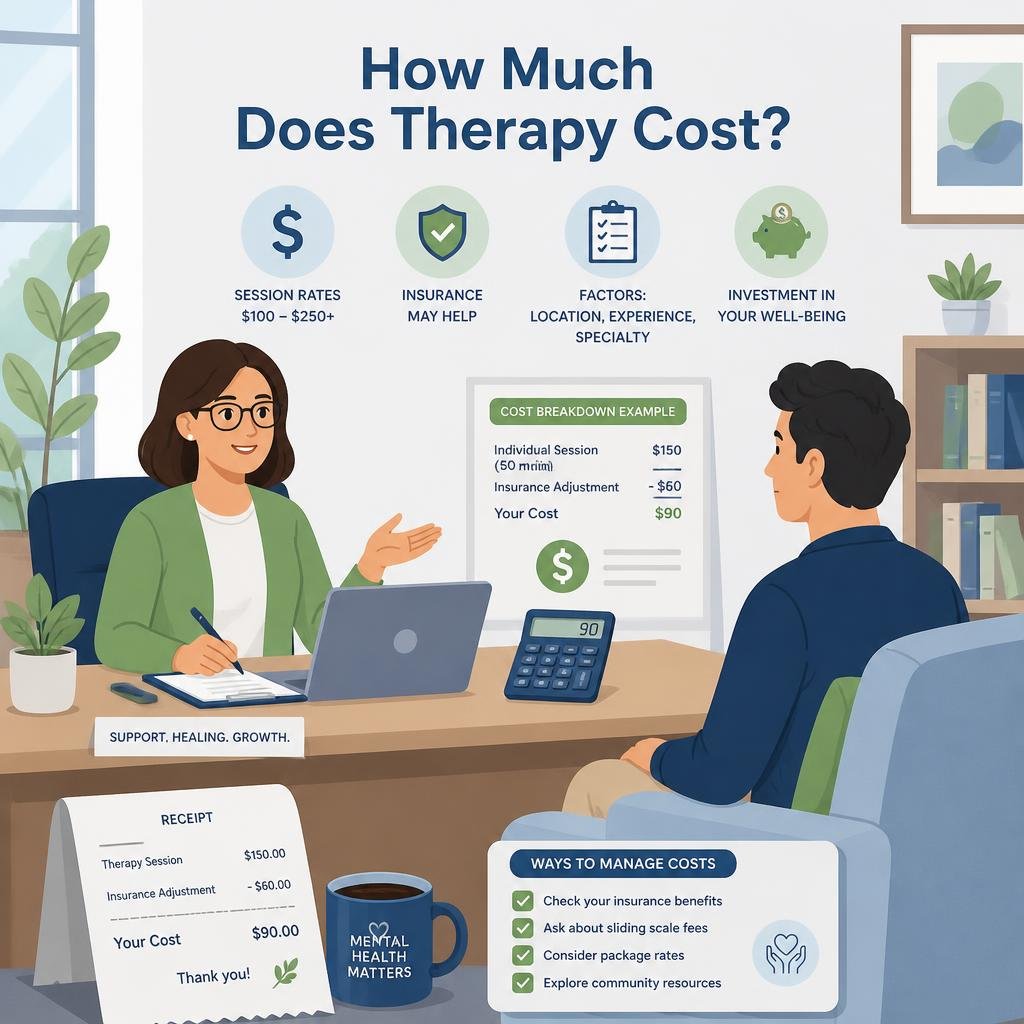
The question of how much does therapy cost usually comes up before the first appointment, and that makes sense. The cost of therapy affects whether you start care, how often you go, and whether you stay consistent long enough to see progress.
In the U.S., the average cost of therapy depends on insurance, provider type, session format, and location. A typical private-pay session often falls between $100 and $250, while insured visits usually mean a $20 to $50 copay.
The most useful way to think about therapy pricing is to separate the sticker price from your real out-of-pocket cost. That simple step gives you a clearer picture of what you can actually afford.
How Much Therapy Costs With And Without Insurance
Therapy pricing can look very different depending on whether you use therapy with insurance or pay therapy without insurance. Your final cost also changes based on whether you see an in-network therapist, an out-of-network therapist, or a provider who offers a sliding scale.
Average Therapy Session Cost In The U.S.
The average therapy cost in the U.S. usually lands around $100 to $250 per session for private-pay care. Licensed Professional Counselors often charge less than psychologists or psychiatrists, and in-person therapy cost tends to be higher in large cities.
A few common ranges are:
- Licensed Professional Counselor (LPC): $80 to $150
- Licensed Clinical Social Worker (LCSW): $90 to $160
- Licensed Marriage and Family Therapist (LMFT): $100 to $175
- Licensed Psychologist: $150 to $250
Therapy Cost With Insurance
If you have mental health benefits, your cost is usually lower than the full session rate. Many plans cover outpatient therapy under mental health parity rules, which means mental health coverage must be treated similarly to other medical care.
With therapy cost with insurance, your out-of-pocket amount is often a copay of $20 to $50 per visit. Some plans use coinsurance or a deductible instead, so your cost may be higher until you meet the deductible.
Therapy Cost Without Insurance
Therapy without insurance usually means paying the full therapy session cost yourself. In most U.S. markets, that means $100 to $250 per session, with some urban areas reaching higher.
If you are budgeting for weekly care, that can add up fast. Four sessions a month at $150 each comes to about $600 per month.
In-Network Vs Out-Of-Network Costs
An in-network therapist has a contract with your plan, which usually gives you the lowest price. An out-of-network therapist may still be usable if your plan has reimbursement benefits, but you often pay upfront and submit paperwork later.
If your plan offers out-of-network coverage, you may get part of the cost back after your deductible. That can make a therapist you really trust more affordable than it first appears.
What Affects The Cost Of Therapy
Therapy rates are not random. Provider training, session type, specialty, location, and how often you meet all affect therapy pricing.
If you are comparing options, these are the main reasons one therapist costs more than another.
Provider Credentials And Licensure
A licensed clinical social worker, licensed professional counselor, and licensed marriage and family therapist may charge different rates because their training paths and business costs differ. Psychologists often charge more, and psychiatrists usually cost more still because they can prescribe medication.
Higher price does not always mean better fit. A therapist who is well trained in anxiety, depression, or couples work and who fits your needs can be more valuable than the most expensive option.
Session Format: Online Vs In Person
Online therapy often costs less than in-person therapy cost because the therapist has lower overhead and can serve more clients across a wider area. Virtual care also gives you access to providers outside your immediate neighborhood.
In-person care may cost more, especially in major metro areas. It can still be worth it if you prefer face-to-face support or need a more structured setting.
Specialty, Location, And Demand
Specialty affects cost because focused training takes time and experience. Cognitive behavioral therapy, couples work, family counseling, and care for complex anxiety can all sit at different price points.
Location matters too. Therapy deserts, where there are fewer providers, can raise demand and limit choices.
In high-cost cities, in-person therapy cost is usually higher than in smaller markets.
Session Frequency And Total Treatment Cost
The number of sessions matters as much as the per-session rate. If you go weekly, monthly therapy costs rise quickly, even at a moderate rate.
A common course of care may run 12 to 20 sessions, so your total treatment cost can range from a few hundred dollars with insurance to several thousand dollars without it.
Affordable Ways To Pay For Therapy
You have more options for affordable therapy than many people realize. Lower-cost care can come from sliding scale fees, workplace benefits, community mental health clinics, and online therapy platforms that reduce overhead.
Sliding Scale And Low-Cost Counseling
Sliding scale therapy is one of the most direct ways to find low-cost therapy. Many therapists lower their fee based on income, and you usually need to ask.
You may also find low-cost counseling through university training clinics or Open Path Collective. These options can bring sessions into a more manageable range, especially if you are paying out of pocket.
Using Insurance, EAPs, And Workplace Benefits
If you have therapy with insurance, start by checking your mental health benefits. Many plans cover therapy visits with a copay, deductible, or both.
An employee assistance program can add several free sessions through your employer. These short-term benefits can be a good starting point if you need support fast.
Community Clinics And Free Mental Health Services
Community mental health clinics and community mental health centers often offer low-cost or free therapy. They may also connect you with medication support, group programs, and crisis care.
Free mental health services are more common than many people expect, especially through local agencies, nonprofits, and public systems. If money is tight, these are practical places to start.
When Online Therapy Can Lower Costs
Online therapy can lower costs by reducing travel time, broadening your provider choices, and sometimes offering simpler pricing. It is often a strong fit if you need consistent support for anxiety, depression, or a life transition.
For many people, virtual sessions also make weekly care more realistic.
How To Find A Therapist That Fits Your Budget
When you try to find a therapist, the goal is not just a low rate. You want a provider whose fees, schedule, and approach match your needs and your budget.
How To Compare Rates And Ask The Right Questions
Ask about the full therapy pricing before you book. You can ask, “What is your standard fee, do you offer a sliding scale, and do you take insurance?”
It also helps to ask how long sessions usually run and whether there are cancellation fees.
How To Find A Provider Through Insurance
If you want to find a provider through your plan, start with your insurer’s directory. Then confirm that the therapist is still in-network, because directories are not always current.
Call the office and ask whether they accept your plan and what your copay will be. That simple step can prevent surprise bills.
What To Look For Beyond Price Alone
Price matters, yet fit matters more over time. A therapist should feel safe, clear, and experienced with your concerns.
If you are dealing with anxiety, depression, couples conflict, or a major life change, look for someone who works often with those needs.
Cost Expectations By Therapy Need And Format
Your therapy session cost can shift based on the issue you want help with and the way care is delivered. Individual therapy, group therapy, couples work, and virtual care do not always follow the same pricing pattern.
Individual Therapy For Anxiety, Depression, And Life Transitions
For anxiety, depression, and life transitions, individual therapy usually sits near the standard private-practice range. Cognitive behavioral therapy is common for anxiety and depression, and its pricing often falls in line with other outpatient therapy visits.
If you are starting care for the first time, weekly sessions are common at the beginning. That means your total cost depends heavily on how many therapy sessions you need.
Couples And Family Counselling Costs
Couples and family counselling often costs more than individual sessions because the therapist is managing more people at once and more complex session dynamics. Rates can range from the middle of the standard band into the higher end.
If you are budgeting for relationship work, ask whether the fee changes for couples sessions. Some practices also offer shorter check-in formats that can reduce total cost.
Virtual Care Vs Chicago In-Person Care
Virtual care is often more flexible and can cost less, especially if your therapist practices mainly online. If you are looking for in-person therapy cost in Chicago, expect prices to lean toward the higher end of the national range.
Chicago-area in-person sessions often cost more than comparable virtual visits. If you want both access and affordability, a mixed model can work well, with most sessions virtual and occasional in-person visits when needed.
Choosing The Right Next Step For Sustainable Care
The best choice is not always the cheapest or the most expensive. You want care that you can keep up with, because consistent therapy is what usually creates change.
When Paying More May Be Worth It
Paying more can make sense when a therapist has the exact specialty you need, a schedule that works, or a strong track record with your concerns. That can be worth it if you need support for couples work, complex anxiety, or a major life transition.
A higher fee may also be justified if the therapist offers a format that helps you stay engaged, such as virtual sessions after work or flexible in-person times.
When Lower-Cost Care Is The Better Starting Point
Lower-cost care can be the better first step if budget pressure is keeping you from starting at all. Sliding scale therapy, online therapy, and community clinics can help you begin now instead of waiting.
If you are not sure what level of care you need, starting with affordable therapy is often smarter than postponing care. You can always adjust later as your needs change.
How Tides Mental Health Can Help
Tides Mental Health is a practical option if you want adult therapy and counselling for anxiety, depression, life transitions, couples, or family concerns.
With both virtual and Chicago-area in-person sessions, you can choose the format that fits your schedule and budget.
If you are trying to balance therapy with insurance or therapy without insurance, Tides Mental Health can help you take the next step with care that is realistic to maintain.