
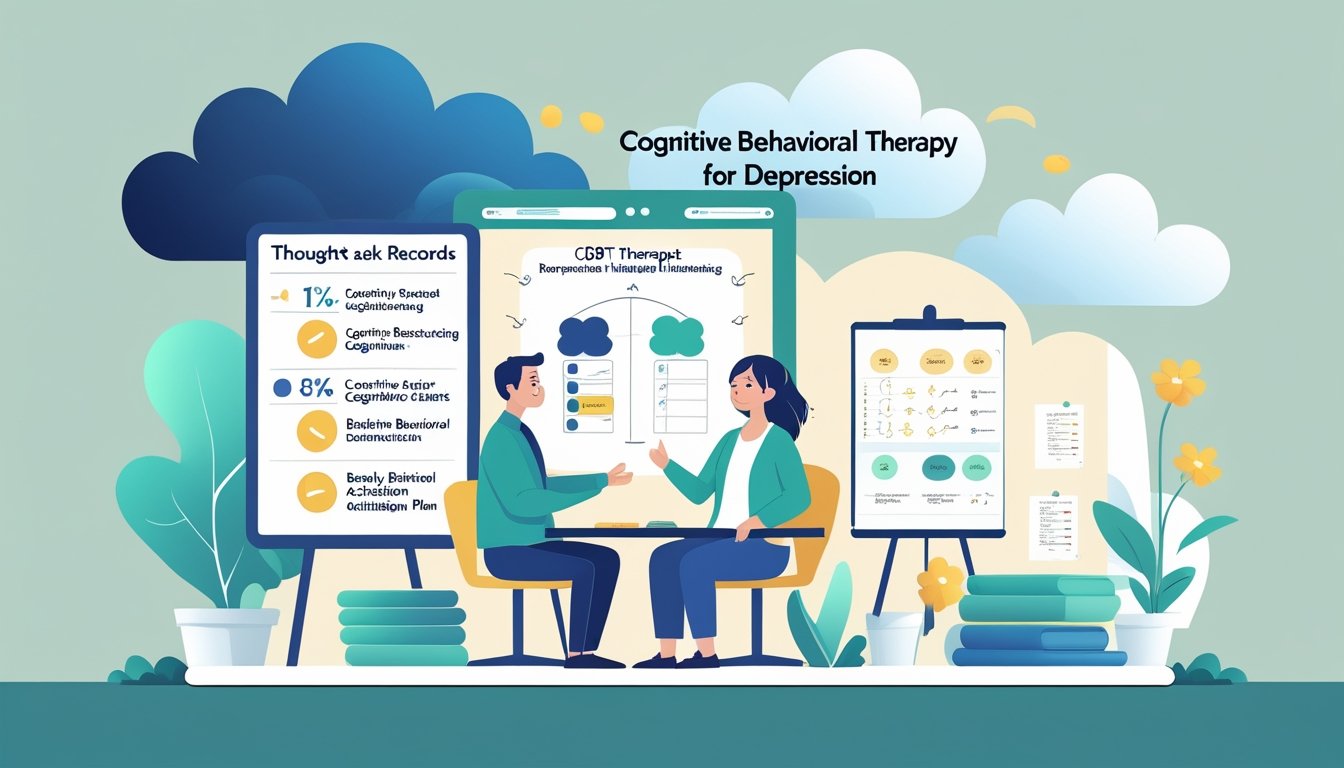
Depression can feel heavy and isolating, but you can learn practical skills to change how you think and act.
Cognitive behavioral therapy gives clear tools that help you spot negative thoughts, test their truth, and replace them with more balanced thinking so your mood can improve.
You can use simple CBT techniques—like identifying unhelpful thoughts, scheduling small activities, and practicing relaxation—to reduce depressive symptoms and start feeling more in control.
This article walks through how those techniques work, how to practice them, and when professional support from Tides Mental Health (virtual or in-person in Chicago) can help you get the most benefit.
Understanding Depression
Depression affects how you think, feel, and act.
It can change your sleep, energy, appetite, and how you relate to others.
Symptoms of Depression
You may feel sad, empty, or hopeless most days.
Mood shifts often last weeks or months and tend not to improve on their own.
Loss of interest or pleasure in activities you used to enjoy is a core sign.
You might avoid social contact, drop hobbies, or skip work.
Physical changes are common.
Expect low energy, slowed movements, headaches, or changes in appetite and weight.
Sleep problems appear as insomnia or sleeping too much.
Cognitive symptoms include trouble concentrating, slow thinking, and frequent negative self-talk.
Some people have thoughts of death or suicide; seek immediate help if that happens.
Causes and Risk Factors
Depression usually comes from a mix of factors, not a single cause.
Biological factors include family history and changes in brain chemicals that affect mood.
A prior mood disorder raises your risk.
Life events and stress add to risk.
Job loss, relationship breakup, major illness, or grief can trigger depression.
Long-term stress makes it more likely to develop or return.
Medical conditions and some medicines raise risk too.
Chronic pain, thyroid problems, and certain prescriptions can worsen mood.
Substance use of alcohol or drugs often makes symptoms worse.
Your age, gender, and social supports matter.
Women and younger adults report higher rates, and weak social ties increase vulnerability.
Impact on Daily Life
Depression can make routine tasks feel overwhelming.
Getting out of bed, handling bills, or caring for children may become hard.
Productivity at work or school often falls, and absenteeism can rise.
Relationships strain under emotional distance, irritability, or withdrawal.
You might miss social events or avoid emotional intimacy, which can erode support networks.
Physical health often declines because self-care drops.
Poor sleep, skipped medical appointments, and bad nutrition create more health problems.
If you live near Chicago or prefer virtual care, Tides Mental Health offers both in-person and mostly virtual therapy options to help manage these effects.
What Is Cognitive Behavioral Therapy?
CBT is a structured, short-term form of talk therapy that helps you change thought patterns and behaviors that keep you stuck.
It focuses on practical skills you can use between sessions to reduce symptoms and improve daily functioning.
Core Principles of CBT
CBT rests on a few clear ideas.
Thoughts, feelings, and behaviors influence each other.
When you spot a negative thought, it often leads to a down mood and avoidance.
Changing one part of that chain can change the others.
A therapist helps you identify specific thoughts that increase depression, test whether those thoughts are accurate, and replace them with more balanced ones.
You also practice small behavior changes—like scheduling enjoyable activities or breaking tasks into steps—to build evidence that you can cope.
Therapists use structured tools such as thought records, behavioral experiments, and activity scheduling.
These tools give you concrete steps and measurable goals.
Sessions are usually time-limited and focused on current problems, not long exploration of the past.
CBT Versus Other Therapies
CBT emphasizes skills and homework.
Compared with open-ended talk therapy, CBT sets clear goals, a session plan, and tasks you complete between sessions.
This makes progress easier to measure.
Other therapies may explore deeper emotions or relationships over many months.
CBT can be used alone or with medication when needed.
It is often delivered in individual or group formats and works well through virtual sessions as well as in-person visits.
If you want a practical, results-focused approach, CBT fits well.
Tides Mental Health offers CBT-style care in Chicago for in-person work and primarily virtual options for convenience.
How CBT Addresses Depression
CBT treats depression by targeting the negative thinking and inactivity that keep depressive episodes alive.
You learn to spot “all-or-nothing” or “catastrophic” thoughts and test them with reality checks.
You also use behavioral activation: planning small, rewarding activities to counter withdrawal and low energy.
Over time, activity increases mood and provides proof that your actions matter.
Therapists teach coping skills for setbacks and relapse prevention.
You build a toolbox—thought records, activity charts, and problem-solving steps—to use after therapy ends.
Tides Mental Health can guide you through these techniques in virtual or Chicago-area in-person sessions.
Core Cognitive Behavioral Therapy Techniques for Depression
These techniques target how you think, what you do, and how you track change.
They give you concrete steps to reduce low mood, increase activity, and test negative beliefs.
Cognitive Restructuring
Cognitive restructuring helps you spot and change negative thoughts that worsen depression.
You learn to identify automatic thoughts, examine the evidence for and against them, and replace distorted thoughts with balanced alternatives.
Start by writing a troubling thought, the situation that triggered it, and the emotion you felt.
Then ask evidence-based questions: What facts support this thought? What facts contradict it? What would you tell a friend who had this thought?
Use short alternative statements that feel believable, not overly positive.
Practice them daily—especially before actions that trigger low mood.
Over time, this reduces rumination and helps you make clearer choices.
Behavioral Activation
Behavioral activation focuses on increasing rewarding and meaningful activities to lift mood.
Depression often shrinks your day to unhelpful routines; this method reverses that by rebuilding a richer schedule.
You and your therapist list activities that used to matter or that fit your values.
Start small with doable steps, then gradually increase difficulty.
Track mood before and after activities to see what helps most.
Plan activities that include social contact, physical movement, and tasks that give a sense of mastery.
Tides Mental Health offers virtual and Chicago-area in-person support to set up and monitor these steps with you.
Activity Scheduling
Activity scheduling turns general goals into a clear, time-based plan.
It removes guesswork and makes it more likely you will do things that improve mood.
Use a weekly grid to assign specific activities to days and times.
Include brief checkboxes for start time, duration, and a 0–10 mood rating before and after.
Review the schedule weekly and adjust based on what lifted your mood.
Balance pleasant activities (relaxing, hobbies) with routine and necessary tasks (bills, chores).
Aim for small, consistent wins; even 10–20 minutes of a valued activity can change how you feel.
Thought Records
Thought records give you a structured way to test negative beliefs with data.
They combine the steps of noticing thoughts, examining evidence, and creating alternative, realistic thoughts.
A simple thought record has columns: Situation, Automatic Thought, Emotion (with intensity), Evidence For, Evidence Against, Alternative Thought, Outcome.
Fill it out after strong negative feelings or recurrent worries.
Review completed records with your therapist or on your own.
Look for patterns—specific triggers or recurring thinking errors.
Use the records to build more accurate beliefs and reduce the power of depressive thoughts.
Challenging Negative Thought Patterns
You will learn to spot the thinking traps that feed depression, replace harsh self-talk with balanced statements, and test your beliefs against real evidence.
These steps help you act more effectively and feel less stuck.
Identifying Cognitive Distortions
Start by tracking your automatic thoughts for a week.
Note the situation, the thought, the emotion, and the intensity.
Look for common distortions like all-or-nothing thinking, catastrophizing, mind reading, and overgeneralizing.
Use a simple checklist to label each thought.
For example:
- All-or-nothing: “If I fail this, I’m a total failure.”
- Catastrophizing: “This will ruin my life.”
- Mind reading: “They think I’m useless.”
Labeling makes these patterns less powerful.
When you see the pattern, you can pause before acting on the thought.
Reframing Negative Thoughts
Reframing means turning a harsh thought into a balanced one that fits the facts.
Ask yourself: What would I tell a friend? What’s an alternative explanation? How likely is the worst outcome?
Try a short practice:
- Write the automatic thought.
- Find evidence for and against it.
- Create a balanced thought and rate how believable it feels.
Keep the balanced thought short and specific.
Repeat it when the old thought returns.
Over time this reduces emotional intensity and helps you make calmer choices.
Evidence-Based Thinking
Treat your thoughts like testable hypotheses.
Gather facts, not feelings.
Use questions such as: “What evidence supports this thought?” and “What evidence contradicts it?”
Record concrete data: dates, actions, quotes, and outcomes.
If a thought says “I never succeed,” list three recent things you completed.
This shifts focus from sweeping claims to real examples.
If evidence is mixed, create a conditional plan: “If X happens, then I will do Y.”
This gives you a clear action instead of ruminating.
For help with these steps, consider TideS Mental Health for virtual or in-person work in Chicago.
Behavioral Strategies in CBT
These strategies help you change what you do so your mood and thinking improve.
They focus on facing avoided situations, solving daily problems, and setting clear, doable goals you can track.
Graded Exposure
Graded exposure breaks feared or avoided situations into small, safe steps you can face gradually.
You start with tasks that cause low anxiety and only move up when you feel ready.
For example, if social events make you anxious, your first step might be texting a friend, then a short coffee meetup, then a small group event.
Track each step with a simple list showing date, event, your anxiety level (0–10), and how long you stayed.
Use this table pattern:
- Step — Date — Anxiety rating — Time spent — Outcome
Repeat steps until your anxiety drops by at least a point or two before increasing difficulty.
Tides Mental Health can guide you through a graded plan in virtual or Chicago-area in-person sessions.
Problem-Solving Skills
Problem-solving teaches you a clear method to tackle everyday problems that worsen depression.
Follow these steps: define the problem in one sentence, list possible solutions without judgment, weigh pros and cons, pick one action, and set a deadline to try it.
Use a worksheet to keep decisions concrete.
Example fields: Problem, 3–5 Solutions, Best Choice, First Action, Review Date.
Review results after the deadline and adjust if needed.
This keeps you from ruminating and helps you make steady, testable changes.
Tides Mental Health coaches this skill in short-term CBT programs.
Goal Setting
Goal setting turns vague wishes into specific actions that lift mood and build confidence.
Use SMART goals: Specific, Measurable, Achievable, Relevant, Time-bound.
Instead of “feel better,” try “walk 20 minutes three times this week.”
Break bigger goals into weekly tasks and log progress.
Add rewards for milestones, like a favorite meal after three weeks of consistency.
Keep goals realistic so you can meet them even on low-energy days.
Track progress in a simple chart: Goal — Weekly Tasks — Completed — Notes.
Tides Mental Health offers virtual planning sessions and local Chicago support to help you set and follow realistic goals.
Mindfulness and Relaxation Techniques
These practices help you notice unhelpful thoughts, reduce physical tension, and calm your nervous system.
You can use them during a mood dip, before bed, or between therapy sessions to manage symptoms and build steady coping skills.
Mindfulness Practices
Mindfulness trains you to notice thoughts and feelings without getting pulled in. Start with a simple daily practice: sit quietly for 5–10 minutes, focus on sensations in your body, and label thoughts (for example, “worry” or “planning”) before letting them pass.
If your mind wanders, guide it back to the breath without judgment. Use a short body scan to check where you hold tension—head, shoulders, chest, or stomach—and spend 1–2 minutes observing each area.
Try mindful walking: slow your pace, feel each footstep, and notice sounds and smells. Track progress with a brief journal: note the time spent, what popped up, and any small shift in mood.
If you want guided practice, Tides Mental Health offers virtual sessions that teach these skills.
Progressive Muscle Relaxation
Progressive muscle relaxation (PMR) reduces bodily tension that fuels low mood and anxiety. Sit or lie down comfortably and work through muscle groups from toes to head (or head to toes).
Tense each group for 5–8 seconds, then release for 20–30 seconds while noting the difference between tension and relaxation. Common sequence: feet → calves → thighs → hips → abdomen → chest → hands → forearms → shoulders → neck → face.
Breathe slowly and match tensing to an inhale, releasing on the exhale. Practice 10–15 minutes daily or use a 5–10 minute version when stressed.
Breathing Exercises
Controlled breathing quickly lowers stress and shifts your nervous system toward calm. Try 4-4-8 breathing: inhale for 4 counts, hold 4 counts, exhale for 8 counts.
Repeat 4–6 times. This lengthened exhale helps reduce heart rate and worry.
Another option is box breathing: inhale 4, hold 4, exhale 4, hold 4. Use diaphragmatic breathing for deeper effect—place one hand on your chest and one on your belly; aim to move the belly more than the chest.
Practice these exercises for 2–10 minutes when you notice racing thoughts or before a therapy session. You can learn and refine these techniques in virtual or in-person sessions with Tides Mental Health in the Chicago area.
Role of Homework and Practice
Homework in CBT turns skills from session ideas into habits you can use daily. It asks you to try new behaviors, track thoughts, and test beliefs between sessions so you improve faster and see what works in real life.
Journaling Assignments
Journaling tasks ask you to write specific events, thoughts, emotions, and responses. Use a simple format: date, situation, mood (0–10), automatic thought, evidence for and against that thought, and a balanced thought.
Do this after upsetting events or once per day to spot patterns. Keep entries short and focused.
Aim for 5–10 minutes per entry so it feels manageable. Your therapist may give prompts like “record a time you avoided something” or “note one achievement.”
Review entries together to identify unhelpful thinking and plan new behaviors. Use a consistent place—paper or a secure app—to track progress.
Tides Mental Health can guide you on prompts and review during virtual or Chicago-area in-person sessions.
Monitoring Progress
Monitoring tracks symptoms, activities, and homework completion to measure change. Use a checklist or brief scale each day: mood (0–10), sleep hours, activity level, and whether you completed practice tasks.
This gives concrete data you and your therapist use to adjust the plan. Set clear, small goals like “leave the house twice this week” or “practice a 5-minute breathing exercise daily.”
Mark achievements and barriers. Reviewing these records in session helps identify which techniques work and when to change tactics.
If you miss tasks, note why and plan a simpler next step. Tides Mental Health offers virtual check-ins that help keep you accountable between in-person sessions in Chicago.
Overcoming Challenges in CBT for Depression
CBT often brings steady progress, but you may hit slow periods, setbacks, or drops in motivation. Practical steps can help you respond to slip-ups, keep practicing skills, and find support when progress stalls.
Addressing Setbacks
Setbacks are common and not a sign of failure. Track the specific thoughts, situations, and behaviors around the setback.
Use a brief mood log: note the trigger, the automatic thought, the behavior you chose, and one small alternative action you could try next time. When a setback happens, pause and use a short grounding or breathing exercise to reduce intensity.
Then use thought-record techniques to test your automatic thoughts with evidence. Break problems into tiny, specific steps—such as “write one sentence” instead of “work on everything”—so tasks feel doable.
If you repeat a pattern, bring it up with your therapist. Tides Mental Health offers both virtual sessions and in-person care in Chicago where you can review patterns, adjust goals, and learn new behavioral experiments tailored to your life.
Staying Motivated
Motivation often fluctuates; plan for low-energy days. Create a simple, weekly activity schedule with 3–5 realistic, pleasurable or mastery tasks (short walks, cooking one meal, 10 minutes of journaling).
Mark completed tasks to reinforce small wins. Link CBT homework to values you care about—relationships, work, or health—so tasks feel meaningful.
Use reminders on your phone and pair a new habit with an existing one (for example, after brushing your teeth, spend five minutes on thought records). If motivation drops for more than two weeks, check in with a therapist.
You can use virtual sessions for convenience or see someone in person in Chicago through Tides Mental Health to revise goals, adjust treatment pace, or explore medication coordination if needed.
When to Seek Professional Guidance
If your low mood or worry lasts most of the day for two weeks or more, you should talk with a professional. Persistent symptoms that interfere with work, sleep, appetite, or relationships signal that self-help might not be enough.
Seek help right away if you have thoughts of harming yourself or feel unable to keep yourself safe. Call emergency services or a crisis line, and reach out to a clinician as soon as possible for care.
Consider professional care when you try coping skills but see little or no improvement. A therapist can teach structured CBT techniques, tailor them to your situation, and track progress with clear goals.
You may prefer virtual sessions if you need scheduling flexibility. Tides Mental Health offers mostly virtual therapy, with in-person options in the Chicago area for those who want face-to-face care.
Ask for a therapist who treats depression, anxiety, life transitions, or couples and family concerns. If you want work with adolescents or children later, check whether the practice plans to expand those services.
Questions to bring to an intake appointment:
- What experience do you have treating depression?
- How will CBT techniques be used in my treatment?
- Do you offer virtual or in-person sessions, and what are the costs?
You have the right to ask about treatment length, frequency, and how progress will be measured. A clear plan helps you decide if a provider like Tides Mental Health fits your needs.
Adapting CBT Techniques for Different Populations
You will learn specific ways CBT changes to match age, life stage, and typical challenges. These changes affect session style, homework, and goals so therapy fits your needs.
CBT for Adolescents
When working with teens, focus on concrete skills and short, active exercises you can practice between sessions. Use behavioral activation with clear steps—schedule small pleasant activities, track mood after each one, and reward effort.
Teach simple thought records with prompts like “What happened?”, “What did I feel?”, and “What thought came first?” Keep forms brief and visual so you use them during or right after events.
Involve caregivers when possible. Share brief skill goals and one or two strategies the family can support, such as praise for trying new activities or helping with routines.
Use tech-friendly homework — apps, photos, or short voice notes — because teens are more likely to engage that way. Adapt language and goals to school, friends, and identity issues.
Address sleep, screen time, and peer conflict directly. If you want in-person care, Tides Mental Health offers Chicago-area sessions; most care is available virtually for flexibility.
CBT for Older Adults
With older adults, prioritize practical problems that affect mood: sleep disruption, chronic illness, grief, and loss of routine.
Start with behavioral activation tied to daily functioning—simple morning routines, light activity, or phone check-ins.
Make activities realistic for mobility and energy levels.
Set very specific, short goals like “walk 5 minutes after breakfast” or “call one friend twice a week.”
Modify cognitive work to match processing speed and memory.
Use one or two written takeaways per session and repeat key points.
Include large-print handouts.
Link thoughts to concrete examples from their life and avoid abstract metaphors.
Coordinate with medical providers when health issues affect mood or cognition.
Family involvement helps, especially for planning activities and managing medications.
You can access virtual sessions through Tides Mental Health or schedule in-person visits in Chicago if you prefer face-to-face care.